






How can a leading bank transform its mobile banking app into a trusted Super App without overwhelming customers or compromising the simplicity of everyday banking? This was the strategic challenge facing NMB Bank, one of Tanzania's leading financial institutions, as it prepared Mkononi for a new generation of digital banking. As NMB’s strategic UX partner, UXDA defined the experience strategy and design foundation to make that possible, bringing global banking standards together with Tanzanian customer expectations.
 NMB's ambition extended beyond redesigning its mobile app. The bank needed a scalable digital experience foundation capable of supporting everyday banking, deeper financial engagement and future partner services — while remaining familiar, trustworthy and accessible to customers with different levels of digital confidence.
Customers already trusted mobile money through their phones and agents. Mkononi had to carry that sense of safety into full banking for people with very different digital skills on a platform NMB could continue to expand with new services and partners.
UXDA completed its engagement in 2024. NMB subsequently launched the upgraded Mkononi Super App in June 2026, marking a milestone in the bank's broader digital transformation.
Client Profile: NMB's Ambition to Lead Tanzania's Next Era of Digital Banking
In early 2023, NMB partnered with UXDA with a goal to set the next benchmark for digital banking in Tanzania. The ambition was to move beyond conventional mobile banking toward a scalable Super App foundation that could strengthen customer relationships, support financial inclusion and enable new digital services.
The timing was critical, as the country’s Fintech market was gaining momentum with competition intensifying. In 2022, McKinsey identified Tanzania as one of 11 key markets poised to drive Africa’s Fintech growth ─ markets that together represent 70% of the continent’s GDP and half its population. NMB and CRDB, which together hold more than half of the sector’s assets and deposits, were competing on digital: in July 2023, while the work was underway, CRDB launched a new SimBanking app with biometric security, digital investments and a layout tailored to each customer. NMB’s customers could now compare its app with both.
Market Opportunity
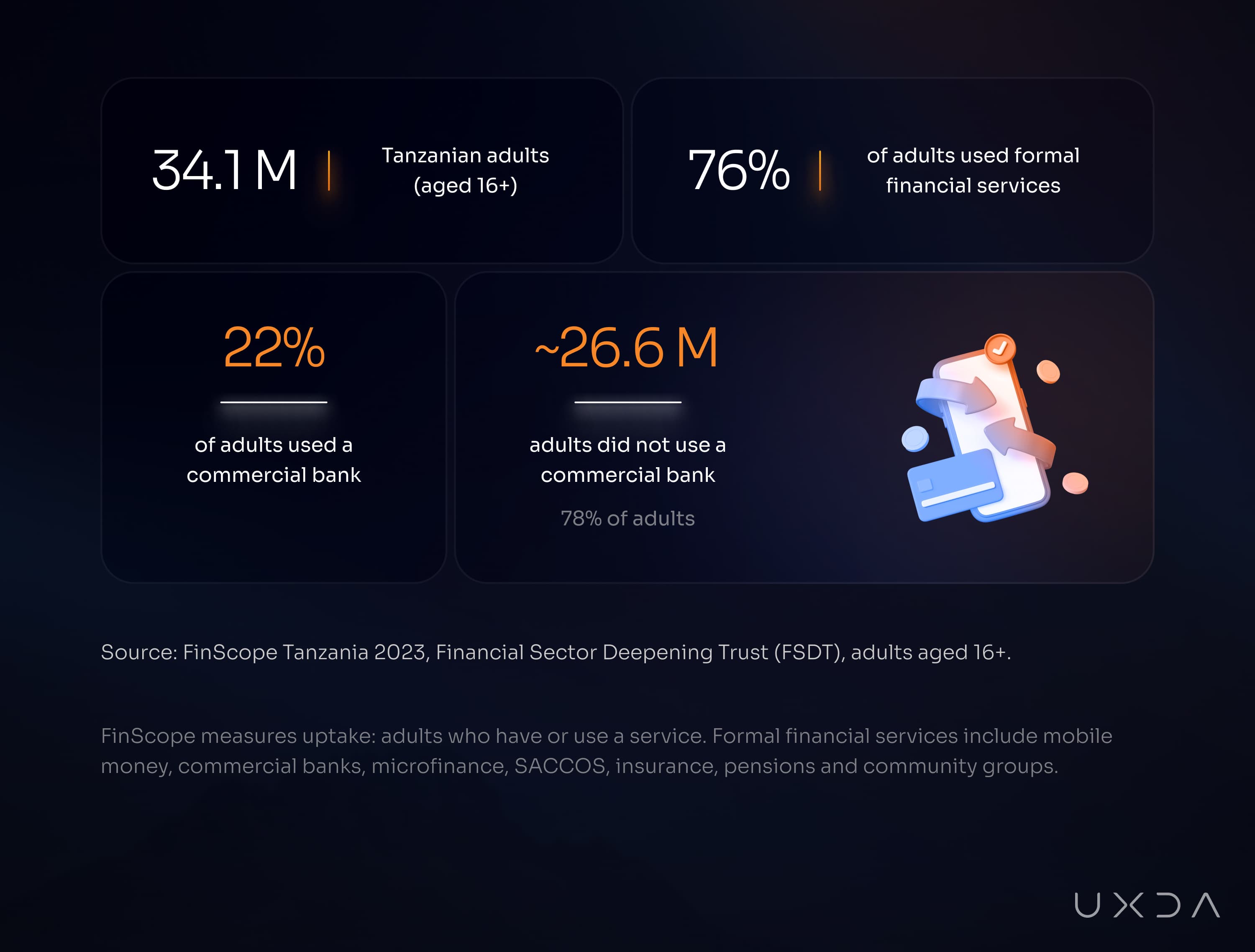
NMB has already brought banking to where its customers are. Its agent network, Wakala ─ made up of local shops where customers deposit and withdraw cash, open accounts and pay bills ─ grew from 8,410 outlets to 73,592 in five years. But an agent, like a mobile money kiosk, is a place money passes through, not where it stays. Being everywhere had made NMB easy to reach, but it had not made it the place customers managed their financial lives. The next opportunity was to make Mkononi a trusted everyday financial platform that customers would choose to use regularly.
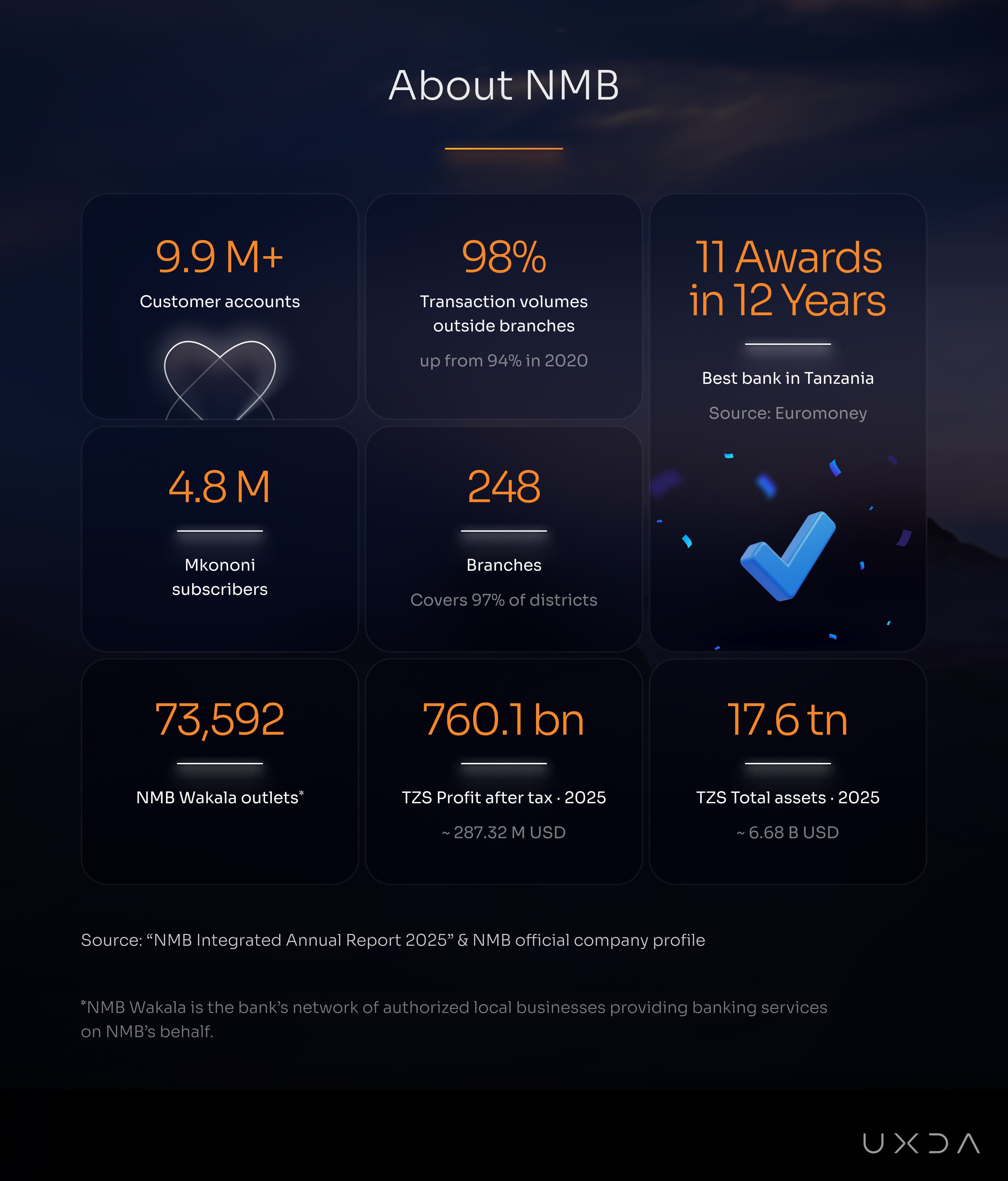
NMB was ready for that challenge. Its reach had never been about size alone: as CEO Ruth Zaipuna wrote in NMB's 2025 annual report, that expansion was "a deliberate investment in access, inclusion and customer needs" rather than a pursuit of scale alone. Separately from this engagement, NMB invested TZS 232 billion ($87.70 M USD) in technology modernization under its previous five-year strategy ─ equivalent to approximately 9% of its cumulative after-tax profit over the same period.
Its successor plan, Agenda 2030 (2026-2030), carries this direction forward ─ deepening financial inclusion, accelerating customer-led growth and building a safer, more connected and scalable bank. At the heart of that ambition is Mkononi (Swahili for "in hand"), the app NMB relaunched as a Super App in June 2026. At the launch, CEO Ruth Zaipuna framed it as one question: "If your life is in your hands, why shouldn't your bank be in your hands too?"
Challenge: Building a Banking Super App Without Losing Customer Confidence
Building a Super App platform is an ambitious leap for any bank, least of all in a market where digital money still means a numbered USSD menu on a phone that is not a smartphone. NMB's challenge was not simply to introduce more digital services. It was to create a banking experience customers would trust enough to adopt, understand well enough to use confidently and value enough to return to.
A Super App increases the number of services available through one platform, but each additional capability also introduces complexity. Load a Super App with a hundred services on day one, and first-time users get lost. Launch with too little, and customers see no reason to switch from what they already use. For NMB, the strategic risk was expanding the ecosystem before the core banking experience had become familiar, reliable and useful in customers' everyday lives.
So NMB challenged UXDA with a complex objective: turn Mkononi from a banking app into the platform its next decade of growth would run on, starting with a foundation strong enough to carry a Super App.
UXDA's diagnosis found the base was fragmented. Cardholders could not access or manage their cards in the app; insurance premiums were paid in the app; and choosing a policy or filing a claim meant using the USSD menu or a branch. Before Mkononi could carry new services, it had to hold the ones customers already had, which necessitated three tasks:
- move customers from the familiar but limited USSD menus to full-scale digital banking;
- bring international standards into Mkononi through locally relevant experiences;
- launch a first version simple enough to adopt, on an architecture that could open new revenue through partner services without a rebuild.
It was a question of sequence. On Kilimanjaro, the summit may be clear from the start, but reaching it depends on a strong base and the right stages. Mkononi faced the same challenge: establish core banking first, then expand as customers and the organization were ready. The ambition remained the same; the challenge was finding the right path toward it.
Super App Complexity Can Undermine Digital Banking Adoption
A Super App can expand a bank’s relevance or make banking feel secondary inside its own platform. The opportunity was significant, and so was the strategic risk: expanding without a deliberate information hierarchy could bury essential banking journeys beneath a growing catalog of services ─ adding capability while making the overall experience harder to accept, understand and use.
Each additional service promises new revenue or deeper engagement, but it also brings more navigation, more choices and more competing priorities. In Tanzania, the alternative to a confusing banking app is one dialed code away: customers do not complain; they simply return to the USSD menu or mobile money they already trust. If services piled up before the banking core became habitual, adoption would quietly stall, and every new service, partner integration and marketing push would be built for customers who had already gone back to what they knew.
The obvious models didn’t fit either. Asia’s best-known Super Apps open on a dense grid of icons, putting every service at the front door. That works in digital economies very differently from Tanzania’s. User interviews and market research showed that NMB needed its own model, where the order in which services arrived mattered as much as how many there were.
Yet even the clearest product structure could not succeed through simplicity alone. Before people would entrust more of their everyday lives to Mkononi, they first had to feel ready to entrust it with their money, which revealed the next challenge of confidence, security and trust.
Building Digital Trust Among Customers Who are Used to Cash, Agents and USSD
The most proven banking interfaces in the world can still fail to earn trust: Users can admire them, see them as credible and still keep their money in cash. Familiar habits feel safe, and changing them takes effort people only spend when the reason is clear. Trust forms when the product reflects how people actually live with their money, when every interaction makes sense and shows added value.
The conventions that make banking feel safe in Europe ─ its terminology, its confirmations, what it shows and what it hides ─ cannot be assumed to work in Tanzania. Designing Mkononi from another part of the world meant UXDA first had to understand how Tanzanian customers managed their money, interpreted risk and sought reassurance ─ from a bodaboda driver (motorbike taxi) hoping to grow his business to a treasury manager overseeing corporate payments.
The data showed where customers stood: digital access was already broad, but regular use and confidence were not. And concerns over security and privacy were already slowing digital adoption.
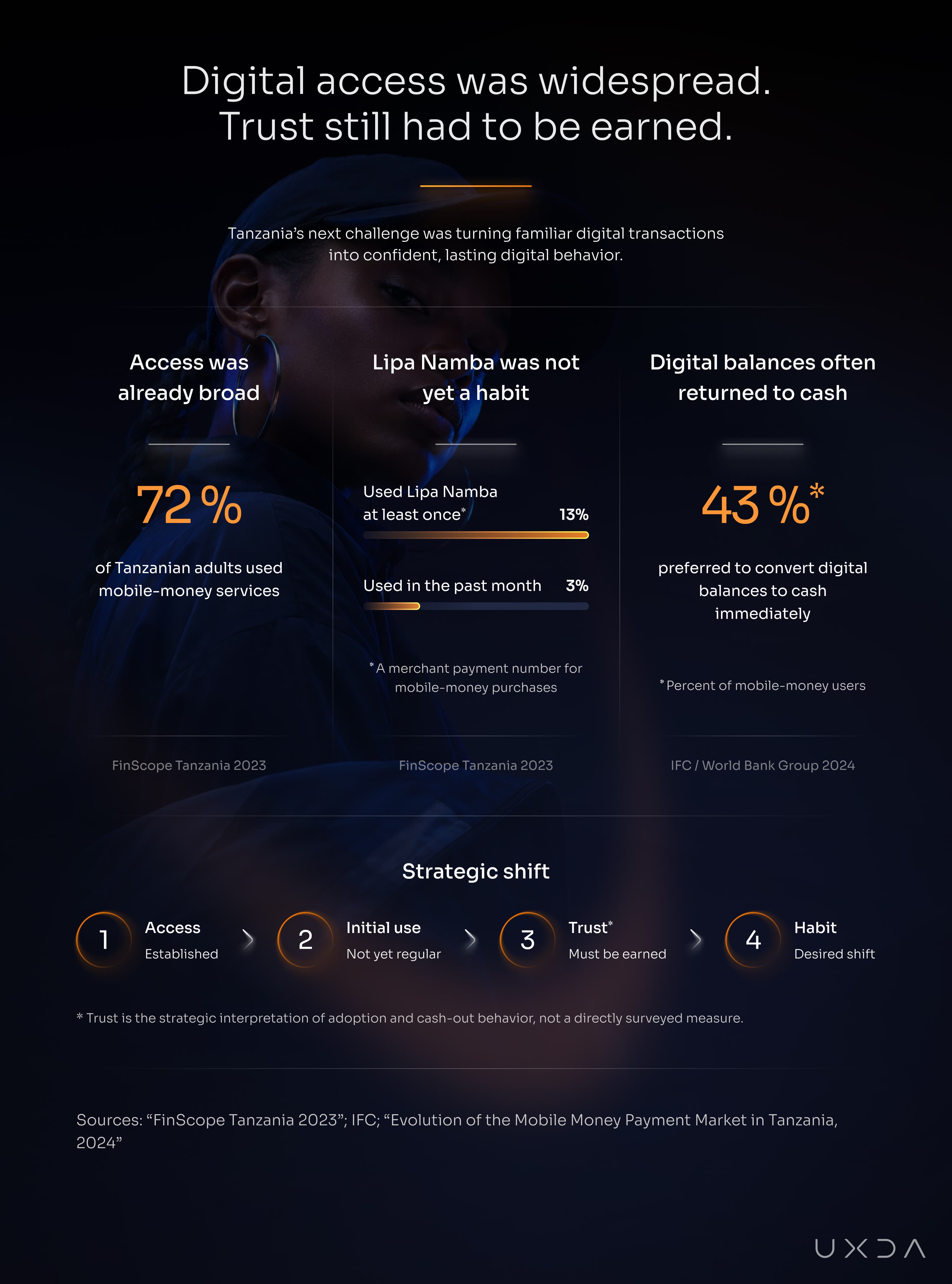
For customers to make Mkononi part of their everyday banking, trust had to build at every step:
- Commitment: reassurance and motivation to step beyond the Wakala agent and USSD menu they already trust;
- Confidence: every transaction visible, so customers always know and control where their money went;
- Connection: familiarity and local relevance to make the app feel personal and spark an emotional connection;
- Consistency: every app interaction behaves like the last, until banking in Mkononi becomes a habit rather than a decision.
Security had to be felt as well as built. A transaction could be technically secure and still feel unsafe if its status was unclear or if an error left someone uncertain about where their money was. For customers making this shift for the first time, uncertainty could read as risk.
But earning trust raised another question: how could an app built to international standards still feel like it truly belonged in Tanzania?
Adapting Global UX Standards to Local Customer Expectations
At the start of the project, the shift away from established behavior raised an unavoidable question: what would trust need to be built on?
NMB could adopt proven global banking patterns to create a reliable, modern experience, but if those patterns were transferred too literally, Mkononi could feel generic and disconnected from Tanzanian customers. On the other hand, relying too heavily on what was already familiar locally could limit the experience NMB was trying to create.
And there was a risk no imported pattern could solve: NMB’s trust had been built by people. In branches and through Wakala agents: someone was there to explain, reassure and make the bank feel local. Mkononi’s digital experience would remove that person so the app itself had to take over those three jobs, or customers would return to the agent and the USSD menu.

NMB needed both because each does a different job: global standards make the app work, and local identity makes it worth choosing. So Mkononi had to have two qualities:
- Reliability, so customers trust it: secure and clear at every step, to the standard of the best banking apps.
- Belonging, so customers choose it: familiar language, Tanzanian culture and a feeling that it was made for their lives, awakening pride in something of their own.
The market advantage lay in closing both gaps, trust and adoption. A decorative layer would not do it; Tanzanian relevance would have to shape how Mkononi behaves, speaks, reassures and shows progress.
Turning NMB’s Brand Into a Digital Identity Customers Recognize
A strong brand can look one way in its advertising and feel completely different in its app. Even established banking brands face this gap as they expand their digital services. It is a common stage in digital banking and a fragile one. UXDA builds Digital Brand Identity side by side with banks’ marketing teams, and project after project the same pattern appears: a brand carefully built over years is clear in its values and trusted by customers. Yet in the digital product, it often sits on top of the experience rather than being embedded within it. How the brand should behave in the app where customers increasingly interact with their bank remains a critical strategic question.
In digital banking, the mobile app in users' hands becomes the institution itself: customers judge NMB by how Mkononi guides them ─ every unclear step, generic message or uncertain transaction status shapes their perception of the bank.
NMB did not have a brand-awareness problem ─ 11 Best Bank awards in 12 years demonstrated its standing. The harder test was what remained without the color and logo: would customers still recognize NMB in how the product led them, communicated with them and handled their money? Closing this gap was one more reason NMB entrusted UXDA with the app's transformation.
Embedding the brand in every interaction could not rest with design or marketing alone; every decision made by the teams building Mkononi would shape the brand and customer experience. As Mkononi expanded, NMB needed Digital Experience Governance ─ shared principles, reusable patterns, clear ownership and the accountability to reconcile priorities across teams and channels. The challenge was to bring all of this together in a scalable experience system that would carry and strengthen NMB's reputation. This could be achieved through how every interaction worked, keeping it coherent with the wider brand and leaving room to evolve as new services and capabilities were introduced to the ecosystem..
Turning a Super App Vision Into a Realistic Roadmap
For a bank, a Super App is easy to imagine and hard to deliver. According to McKinsey, only 30% of banks succeed with their digital strategy, one of the main reasons being that they struggle to tie individual projects to real business outcomes.
Success depends on execution, and execution starts with an honest assessment of what the bank can really deliver: its technology, internal capabilities, development partners and budget. This is where NMB demonstrated leadership. It was willing to test its original ambition against what could realistically be delivered, reconsider the initial scope and commit the time and resources needed to build a stronger foundation. UXDA’s role was to structure these decisions, clarify trade-offs and translate the long-term vision into an actionable product direction.
Vision creates possibilities. Leadership decides the sequence.
Mkononi’s product strategy covered 12 retail services and five corporate ones ─ from savings, loans and insurance to investing, forex and ticket booking. Each competed for the same limited resources: customers’ attention, development capacity and budget.
Corporate internet banking had an additional constraint: Built on the bank’s existing technology platform, it had to differentiate itself through experience, one that felt consistent with retail Mkononi, so corporate and retail customers would recognize the same NMB across channels. This meant establishing a shared experience logic extending beyond the mobile app to internet banking, corporate services, customer support and future partnerships.
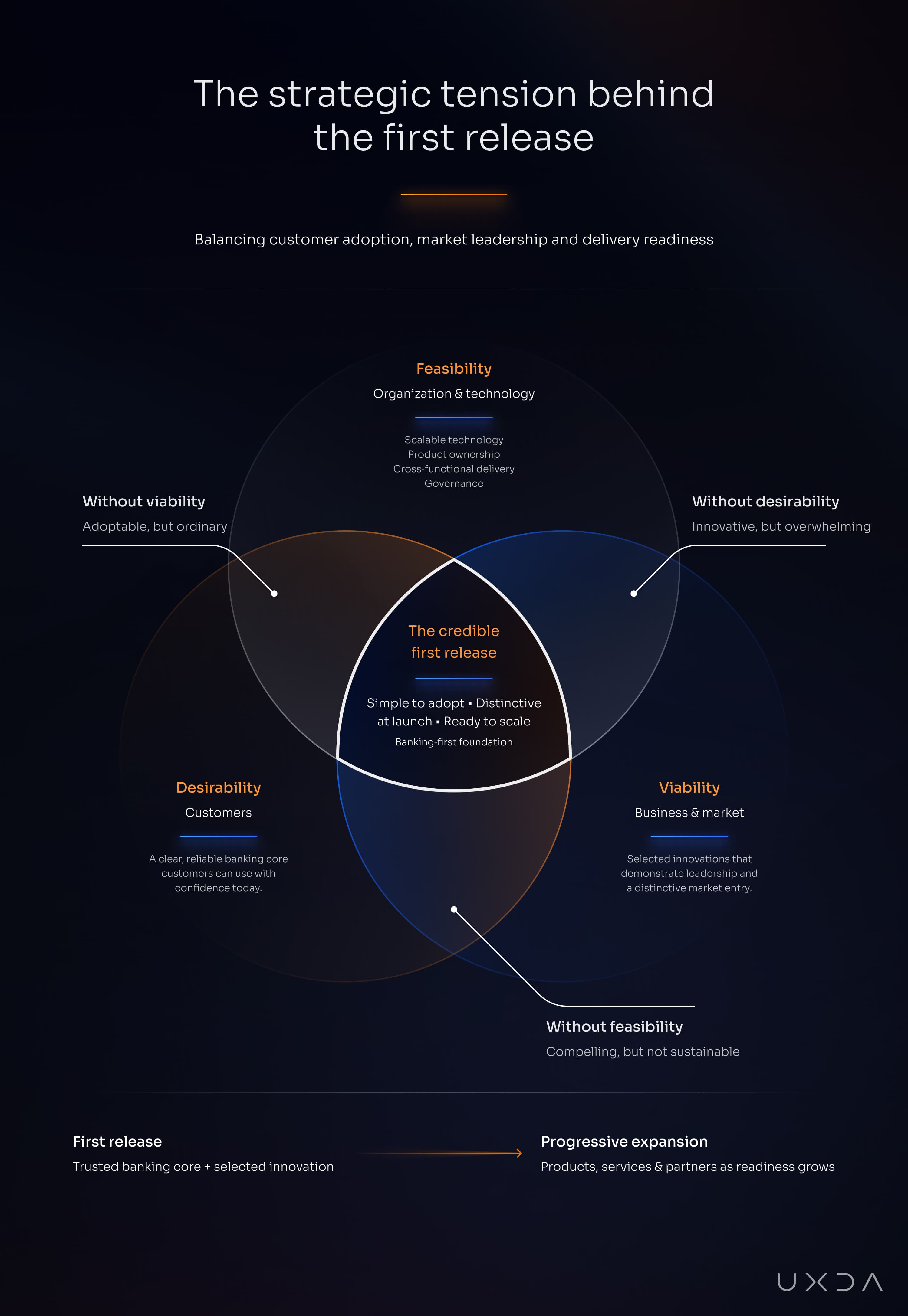
The guiding principle was to design around customers' lives while ensuring measurable business value. But every feature considered for the first release had to pass three tests at once: would customers use it with confidence, would it move NMB forward in the market, and could the bank deliver and support it? Success depended on balancing all three. Without desirability, even innovative features risk low adoption. Without viability, customer value may not translate into sustainable business results. Without feasibility, even the strongest proposition cannot be delivered or scaled effectively.
UXDA's Diagnosis: Five Gaps Between Super App Ambition and Adoption
UXDA examined the transformation through five interconnected UX and business gaps, combining customer needs, market expectations, brand positioning and organizational capabilities to identify where the greatest risks and opportunities lay.
1. Adoption — From familiar habits to everyday digital banking
Would customers move beyond trusted Wakala agents, mobile money and USSD menus to manage more of their financial lives through Mkononi? The challenge was to make the transition feel natural, reduce the effort of learning new interactions and give customers a clear reason to return.
2. Trust — From perceived risk to financial confidence
Would customers feel safe, informed and in control when managing money digitally? Mkononi needed to make transactions predictable, communicate their status clearly and provide reassurance and recovery options when something went wrong. Technical security alone would not guarantee customer confidence.
3. Advantage — From functional parity to meaningful differentiation
Why would customers choose Mkononi over familiar alternatives or competing banking apps? Simply adding more features was insufficient. The experience needed to deliver recognizable everyday value, simplify financial management and create compelling reasons to deepen the relationship with NMB.
4. Brand — From visual recognition to Digital Brand Identity
Could customers recognize NMB through the experience itself, beyond its logo and colors? The challenge was to translate the bank's values and Tanzanian identity into how Mkononi communicates, guides financial decisions and supports customers, creating an experience that feels both globally credible and distinctly local.
5. Alignment — From ambitious vision to sustainable execution
Could NMB's business, technology, marketing and operational teams deliver and continuously evolve one coherent experience? The transformation required shared priorities, clear experience principles and alignment among customer expectations, technical feasibility and organizational readiness.
Solution: Making NMB Mkononi Identity Globally Credible and Unmistakably Tanzanian
What do customers remember about a banking app that works perfectly? Rarely the technology behind it. What customers do notice is how it made them feel, and that impression forms before they use a single feature.
Technology and features can be replicated. A distinctive experience is far harder to copy because Digital Brand Identity transforms a financial institution's brand promise into recognizable digital interactions, communication and service behavior.
For NMB, this meant connecting the reliability and clarity of global banking standards with a distinctive experience rooted in Tanzanian identity. Together with UXDA, NMB built that into Mkononi: a banking-first foundation, reliable from day one, recognizably NMB and unmistakably Tanzanian, and designed to scale as new services are introduced.
How Did UXDA Create a Distinctive Digital Brand Identity for NMB Mkononi?
The Heart of Tanzania concept brings expertise and belonging into one interface: global expertise that makes Mkononi dependable and a Tanzanian identity drawn from Kilimanjaro that makes it personal. Kilimanjaro, a summit the world knows and Tanzanians claim as their own, gave Mkononi a symbol of progress that customers see as theirs.
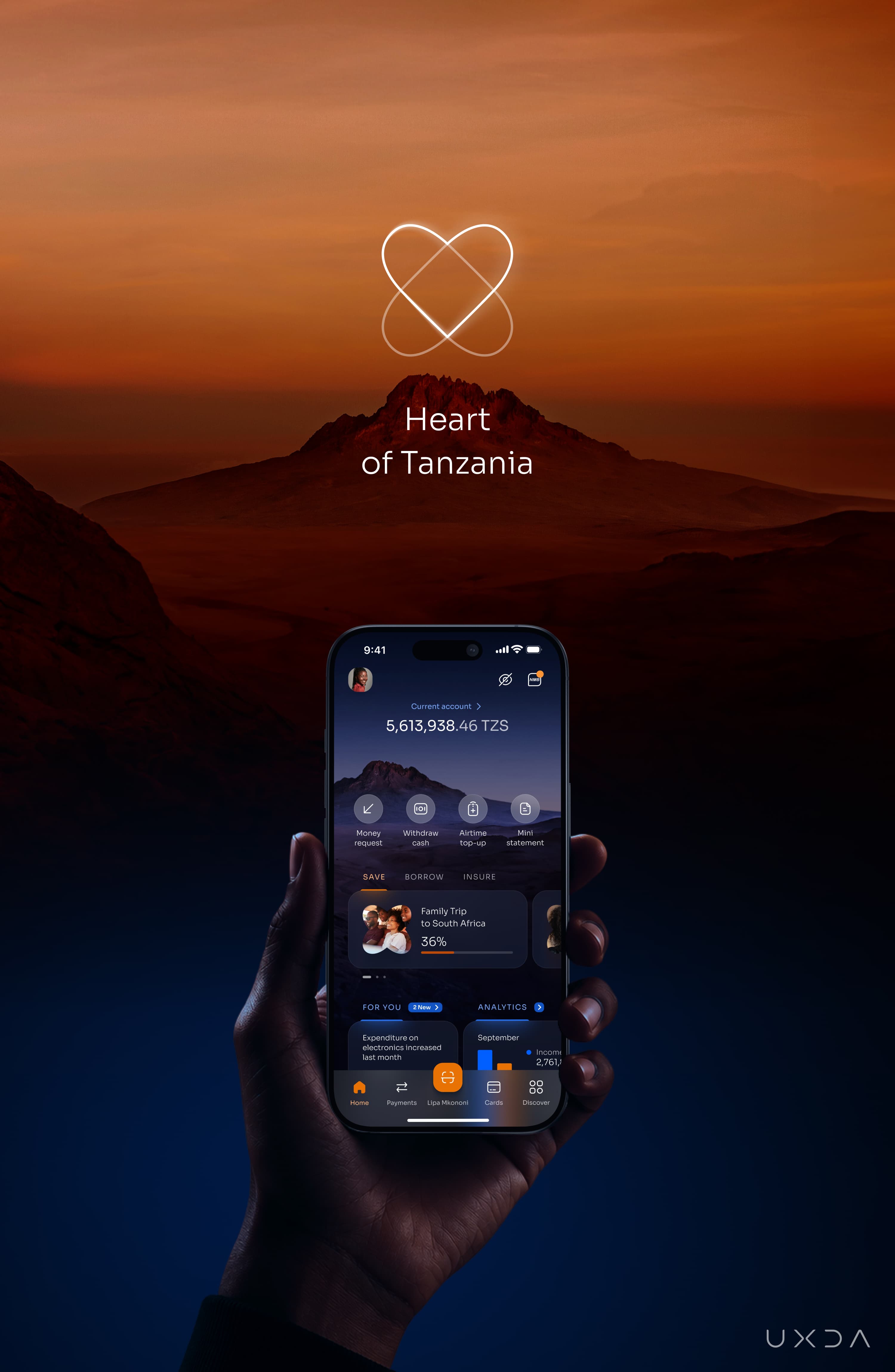
Every major design decision followed from that idea:
Confidence from global expertise. A carefully ordered interface brings the precision and predictability customers expect from a leading bank. Bright accents guide the eye to what matters, so light becomes a quiet sign of progress.
Warmth from local identity. Landscape textures and Kilimanjaro imagery ground the app in a place customers know.
Customizable app moods make that connection personal. Instead of one fixed corporate look, customers choose a mood drawn from a Tanzanian sky:
- Energy vibrance: NMB’s own orange and blue in motion.
- Velvet dawn: the deep blue of dawn over the mountain.
- Sunset harmony: the warm orange of a Tanzanian dusk.
- Early sunrise: the pale morning light.
People keep room in their minds for only a handful of brands, the ones that stand for something clear and meaningful to them. NMB had earned that place through its branches and decades of trust. The question was whether it could hold it on a phone. Take away the logo, and most banking apps look alike, so Mkononi had to express NMB’s identity through the experience itself: how it leads customers (one clear sequence for every payment), how it speaks to them (plain language in every message) and how it handles their money (a visible status and a route to a live person when something goes wrong). This is where brand recognition becomes customer confidence, built through every interaction.
NMB's mission and brand values were embodied in three product principles:
- Expertise: making customers feel safe: clear hierarchy, precise typography, readable data and one predictable sequence for every transaction.
- Empathy: ensure customers feel understood: plain language, guidance in context, no information overload and a visible route from digital help to a person.
- Step Ahead: helping customers feel they’re moving forward: personalization, relevant insights, goal-based savings and a visual language that points to what comes next.
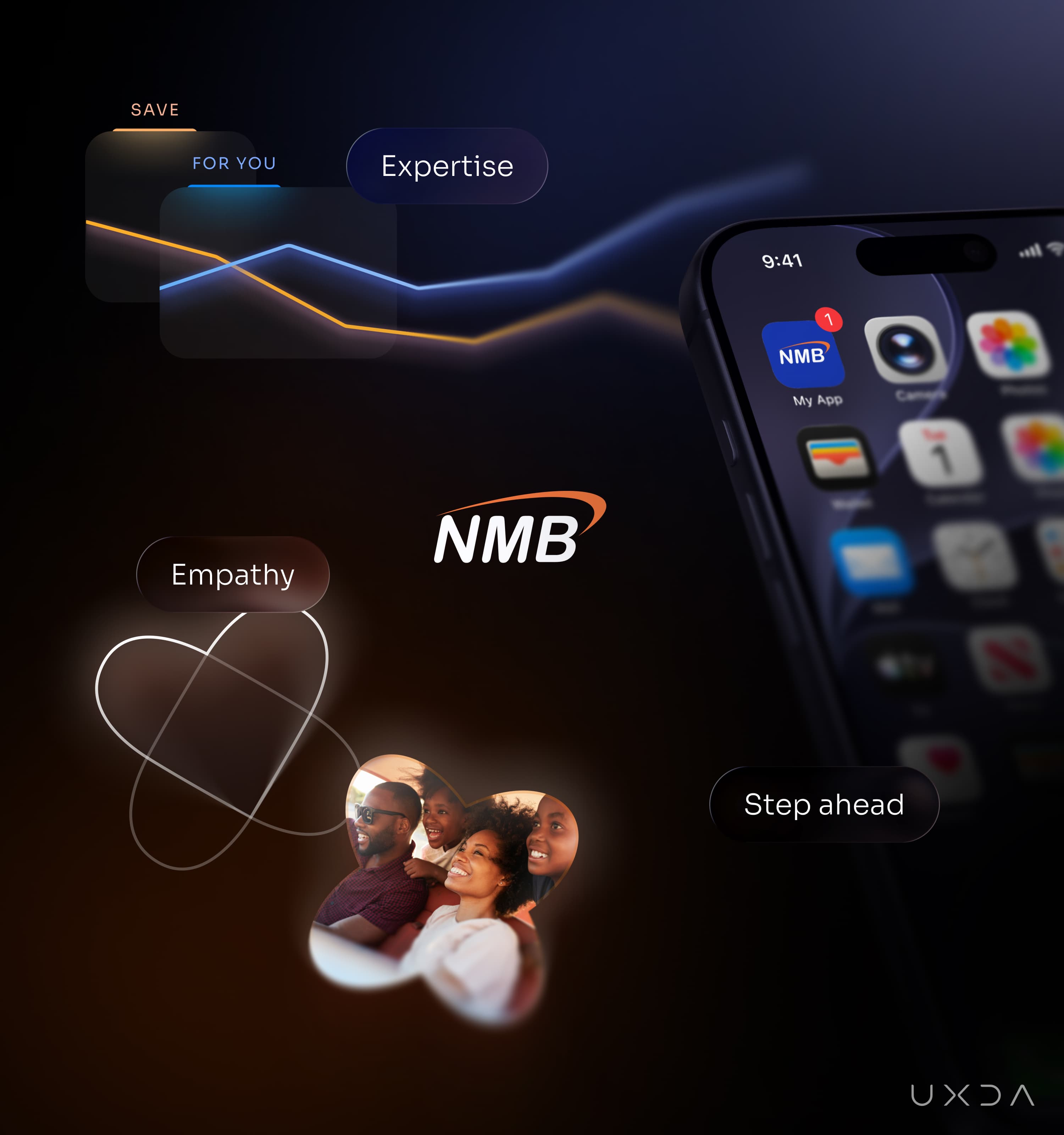
The identity became a system. NMB’s recognizable core was protected and extended across product, interaction and motion. Sora typography gives financial information authority. Burnt Tangerine and Cobalt Royal colors are used to mark actions and moments that need attention. Custom 3D illustrations make services and states easy to recognize. And the Heart of Tanzania symbol frames photos of people and goals customers recognize.
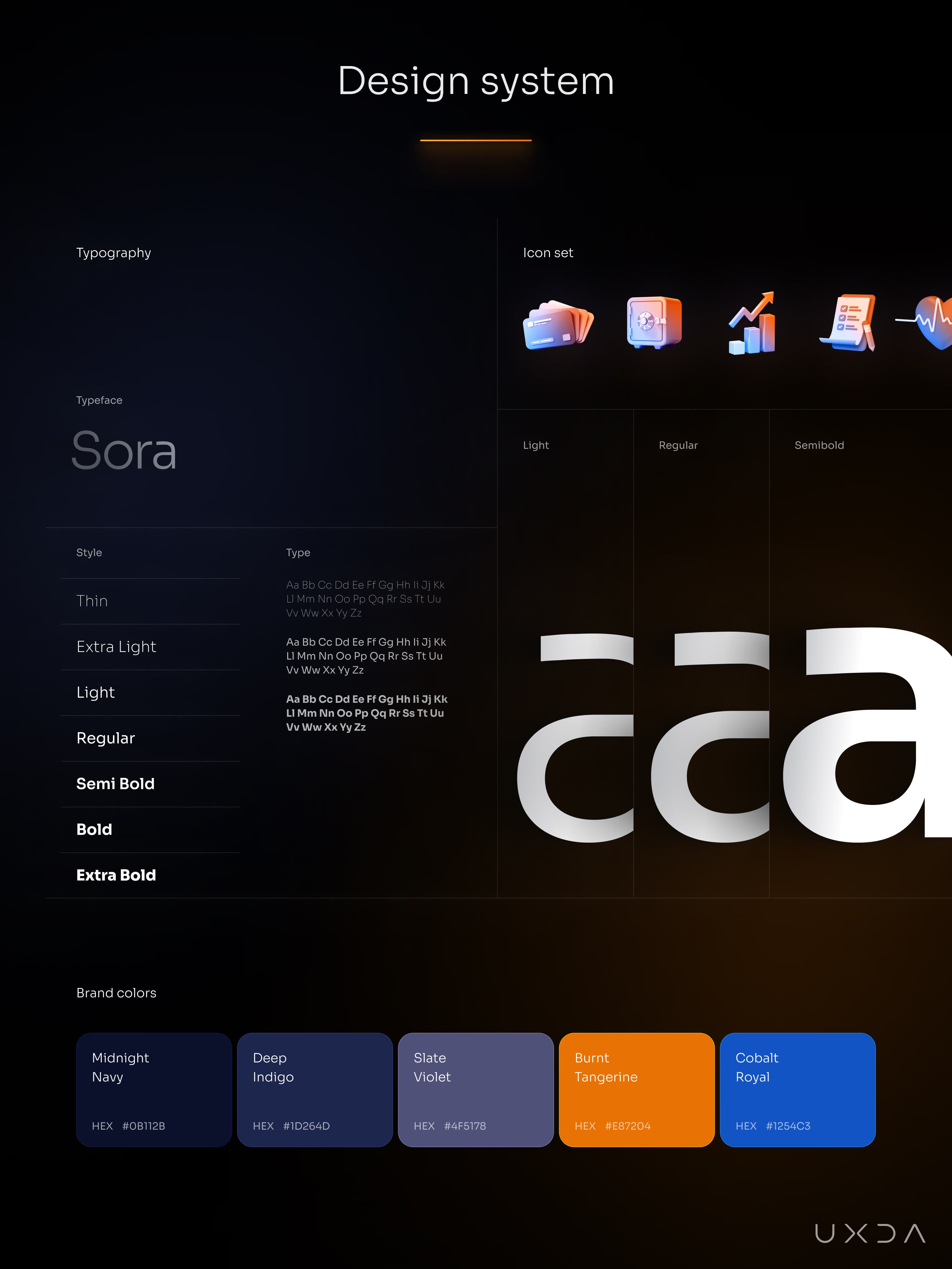
The system became reusable building blocks. Navigation, cards, input flows, transaction states and feedback were built once as reusable patterns and not designed screen by screen. They carry across every screen ─ from a receipt to a support chat. Every new service follows the same interaction principles, visual hierarchy and NMB character, reducing fragmentation and enabling teams to scale the experience consistently.
Many banks put their brand on their app. NMB's brand now runs inside it.
How Mkononi feels is both a brand and business growth decision. A Super App grows when each customer takes more from the same bank and when customers feel attached to it: In retail banking, emotionally engaged customers bring 37% more annual revenue, hold more products and maintain higher deposit balances than disengaged customers. By translating brand values into everyday interactions, experience design can deepen engagement, broaden product adoption and strengthen long-term customer relationships.
Super App Information Architecture: Keeping Everyday Banking at the Center
Before any screen was designed, UXDA defined the information architecture for current and future services, aligning it with NMB’s long-term Super App vision and securing stakeholder approval. In a Super App, the information architecture is one of the key strategic decisions. Screens can be redrawn, but structural decisions become increasingly costly to change as services and dependencies grow. Settling the architecture early also keeps delivery moving because teams stop reopening the same fundamental questions.
A scalable banking Super App information architecture organizes financial services so customers can complete essential tasks easily while allowing the institution to introduce new capabilities without creating unnecessary complexity. For NMB, UXDA established a banking-first structure that prioritized immediate financial clarity and everyday actions before introducing additional products, insights and future ecosystem services.
The architecture rests on three principles: hierarchy, so the most important information comes first; relevance, so customers see what fits their needs; and guidance, so the next step is always clear. It gives NMB’s teams a shared decision-making framework for deciding where a new service structurally belongs before it is even built.
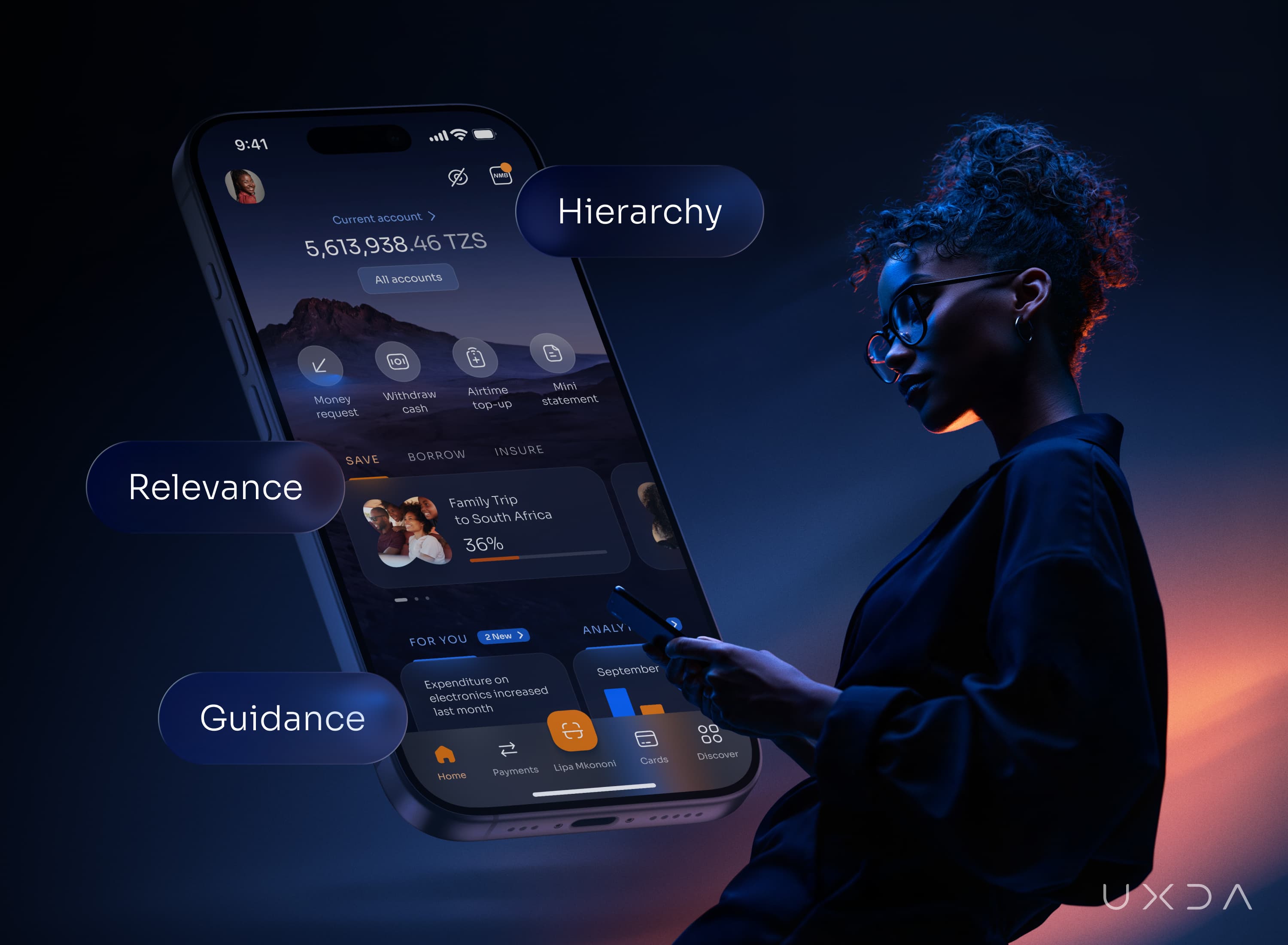
The architecture had to do two things at once: show customers their financial position the moment the app opened, and give NMB room to add services without losing that clarity. The dashboard shows how, in three layers.
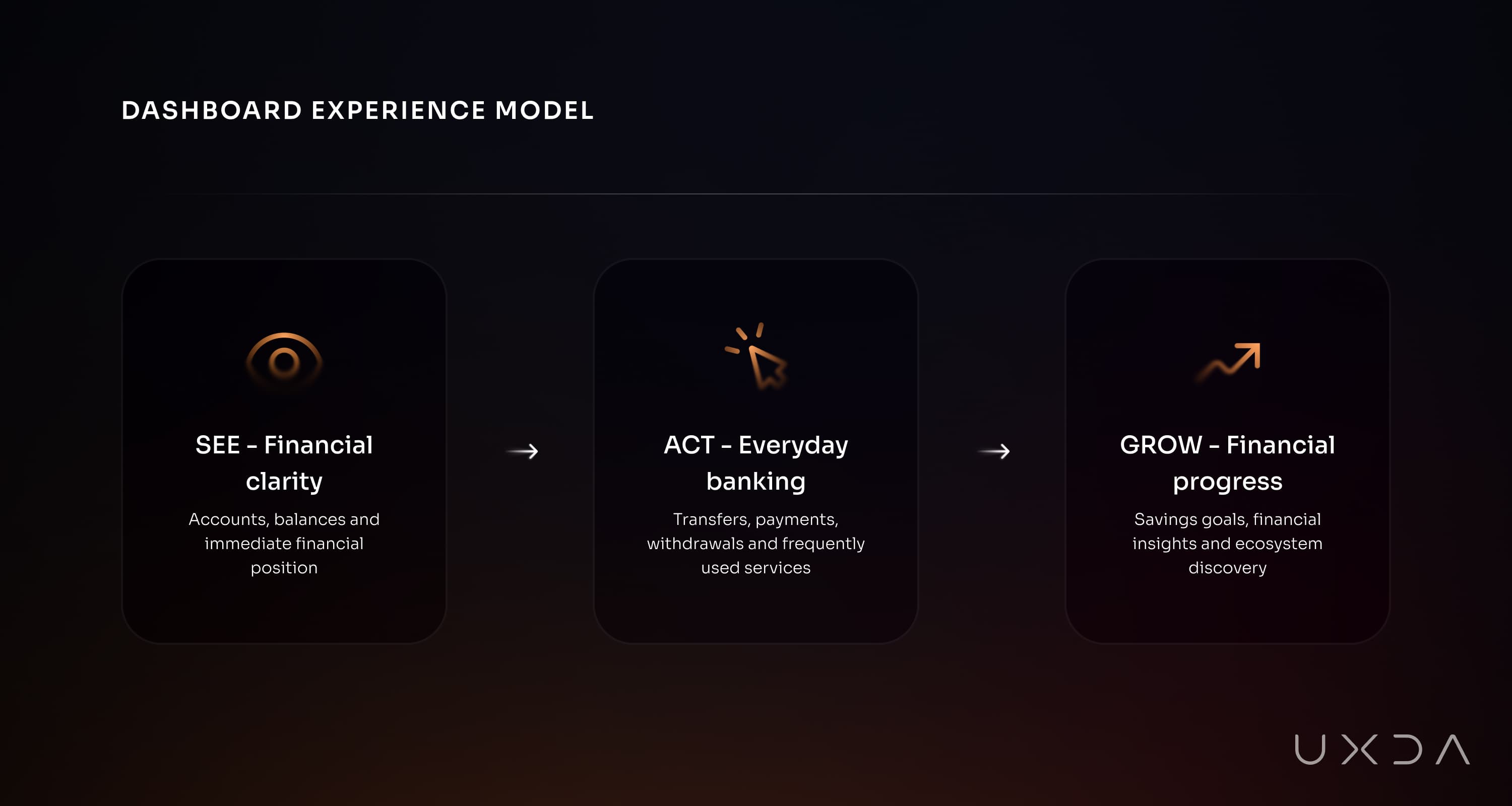
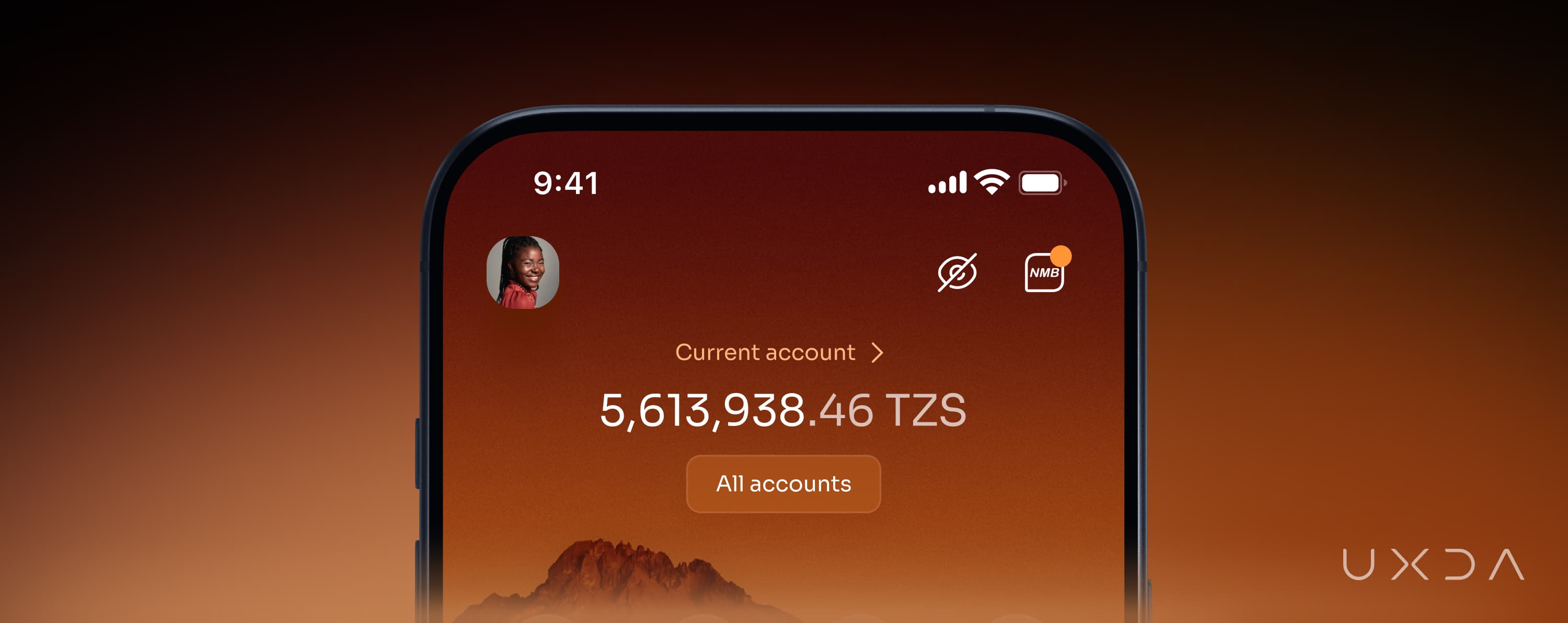
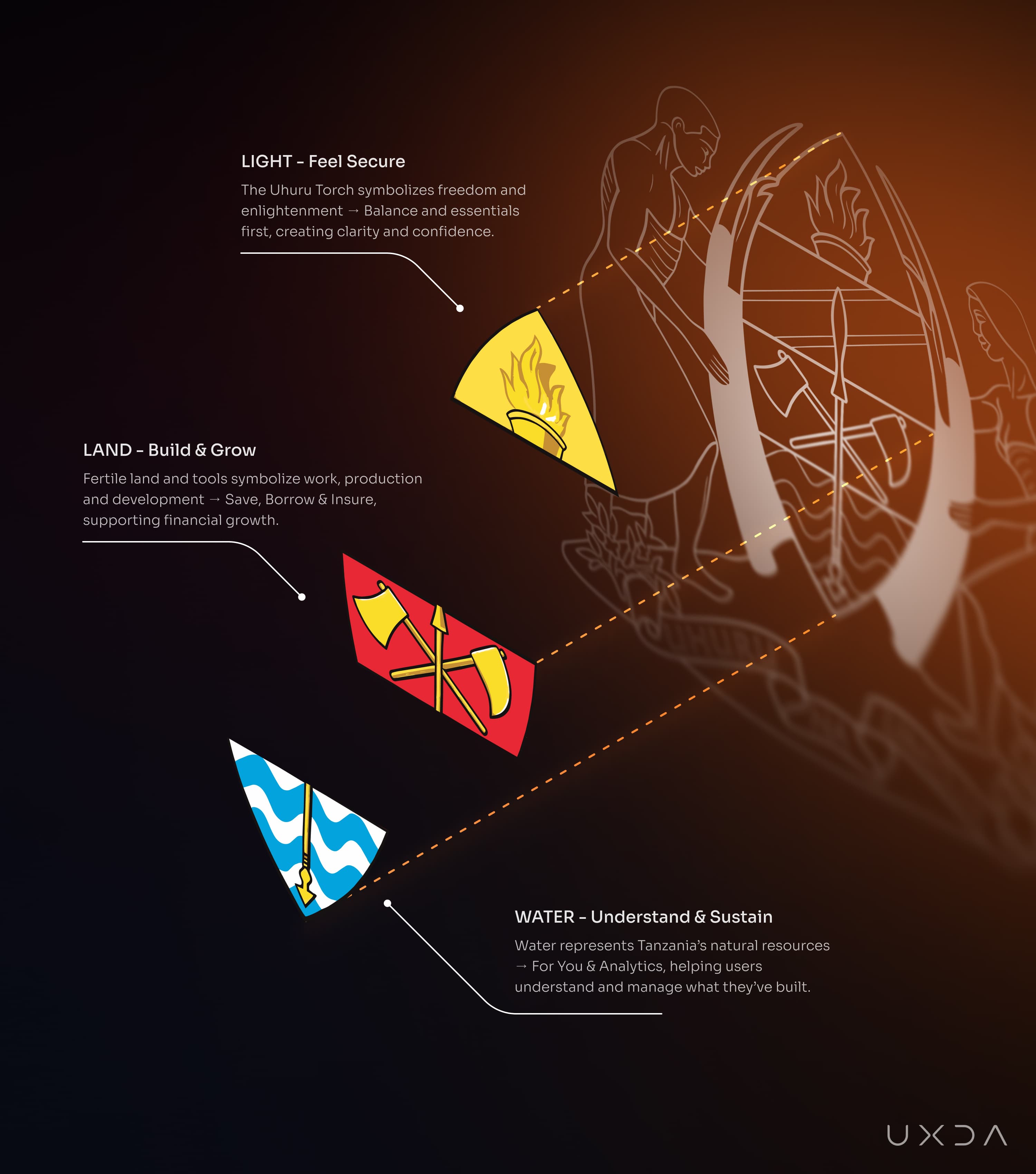
1. See - Establish financial clarity. The top of the screen is deliberately spacious. Balances and accounts are prioritized so customers see where they stand before being asked to do anything.
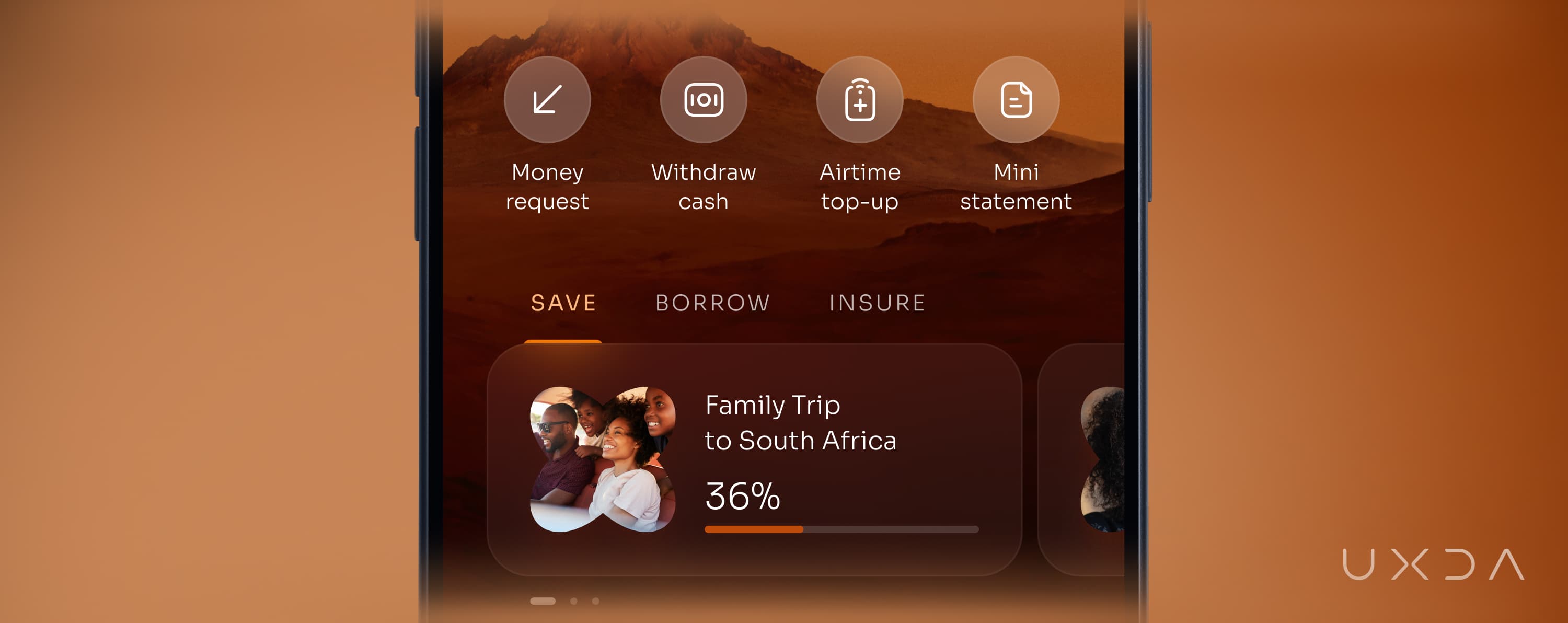
2. Act - Enable everyday banking. Next come the actions customers use most: money requests, cash withdrawals, airtime top-up and mini-statements, which customers can rearrange to suit their habits. Below them sit save, borrow and insure, the products that help build financial stability with goal-based savings that make progress visible.
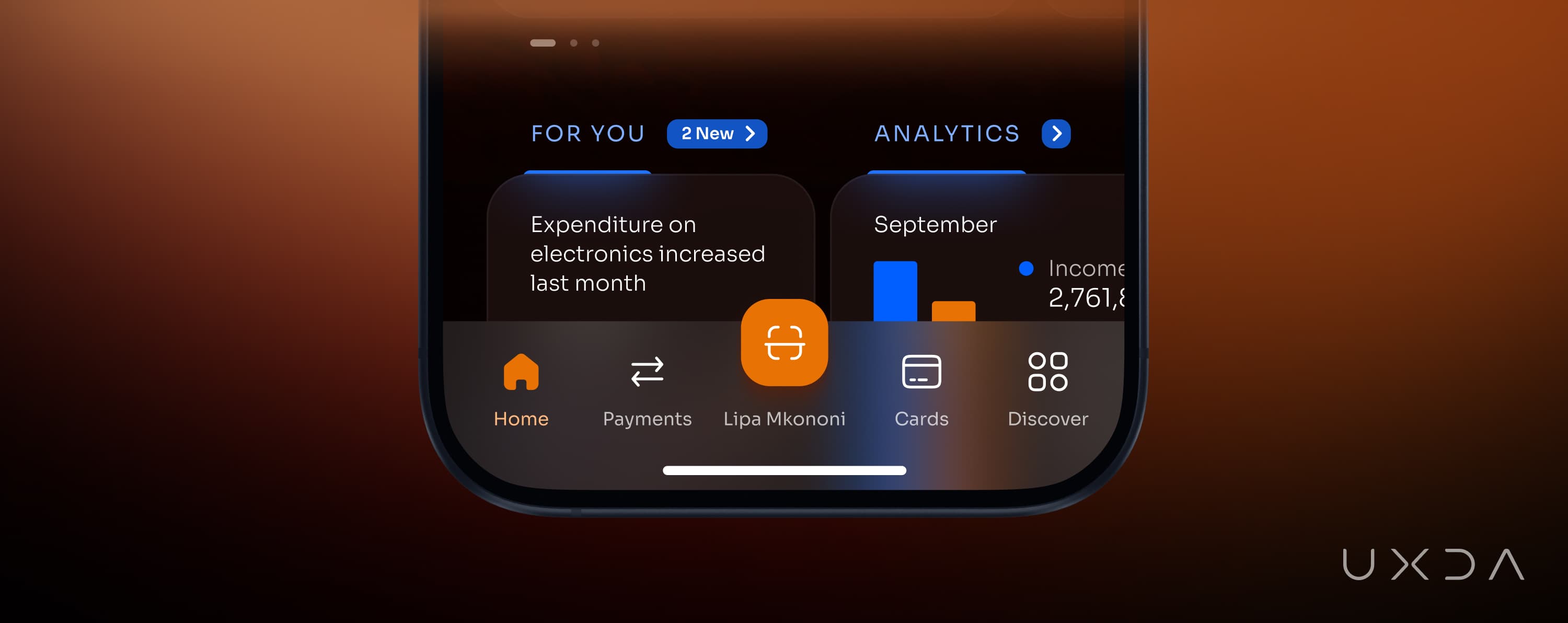
3. Grow - Support deeper financial engagement. Only after the banking core has proved its value does the wider layer appear: For You insights on spending changes, analytics on income and expenses and Discover, a separate, deliberate entry point into the wider ecosystem.
Each layer leads naturally into the next, creating a progression from immediate utility to broader financial engagement: see where I stand → complete a familiar action → repeat it with less effort → understand progress → manage more finances digitally.
The three layers also echo Tanzania’s Coat of Arms, the national emblem. Its shield is divided into layers, each with its own symbol, under the motto Uhuru na Umoja (Freedom and Unity). This cultural reference added another storytelling layer to the dashboard’s structure. The Uhuru Torch, a symbol of freedom and enlightenment, became See: the light that shows customers where they stand. Land and tools, a symbol of work and development, became Act: the everyday actions and products customers use to build. Water, representing the country’s seas and lakes, became Grow: the insights that help customers understand and sustain what they’ve built. The parallel was creative inspiration, not the basis of the architecture, which was grounded in customer needs and clear task priorities.
Super App Roadmap: Launch the Banking Core First, Then Scale the Ecosystem
Building a banking Super App requires more than deciding which features to launch. It requires a phased experience strategy that balances customer value, commercial priorities and the institution's ability to deliver and support each capability. For NMB, UXDA established a focused initial scope while creating an information architecture that could accommodate future products and partner services.
So the real question for NMB wasn’t what to launch next, but what to launch now without limiting what comes next. The answer was a focused first release that NMB could realistically deliver: neither ordinary mobile banking nor the full Super App vision at once.
The approach separated two layers: a stable experience foundation built around familiar banking journeys with consistent interaction principles and a flexible ecosystem designed to accommodate additional financial and beyond-banking services over time.
- Banking-first: Protect familiar and high-frequency financial tasks.
- Progressive expansion: Introduce new capabilities as value and readiness are established.
- Shared experience system: Apply consistent principles across retail, corporate and future partner experiences.
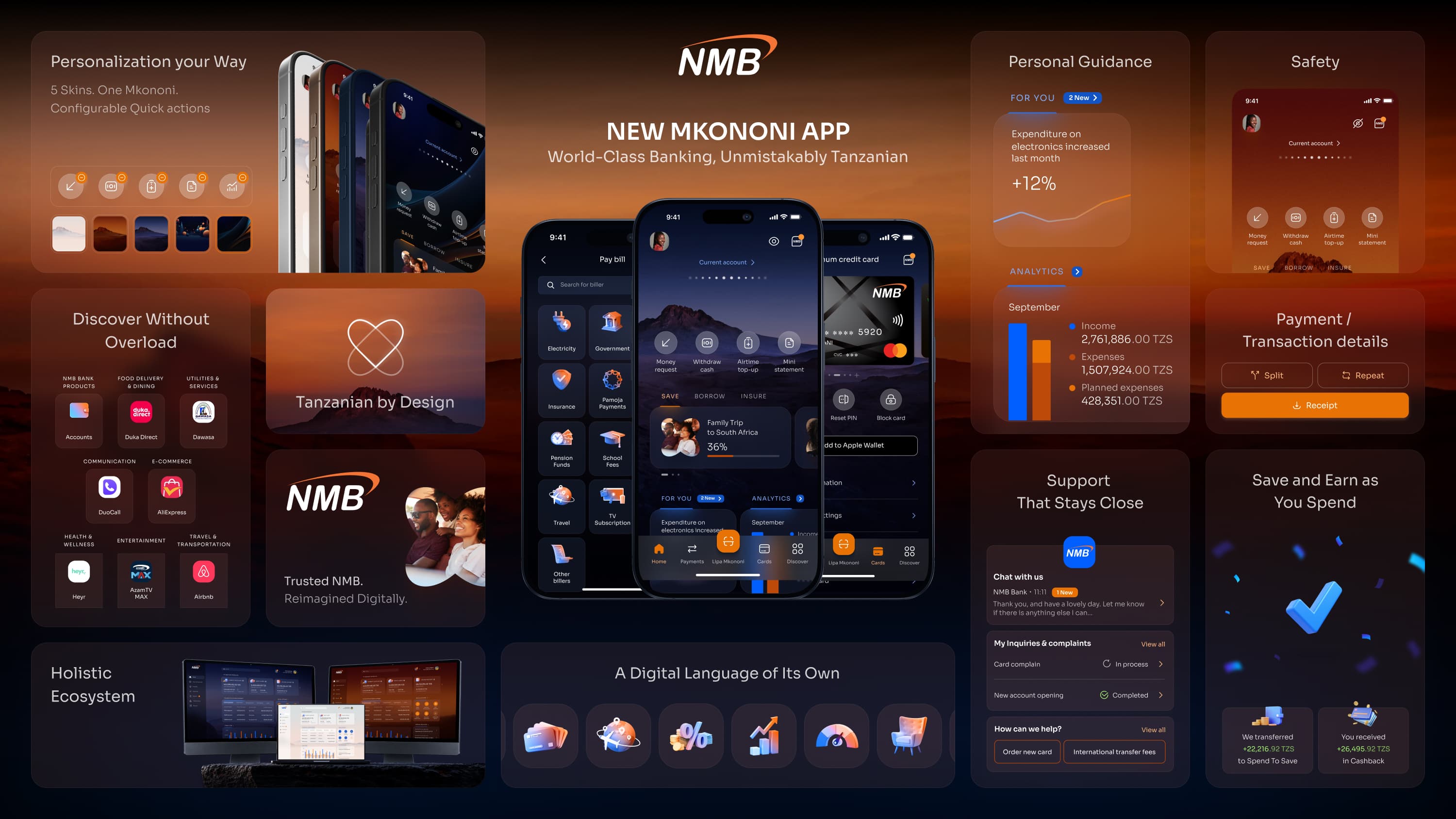
Customers get complete everyday banking from day one, and the product is built to grow:
- Personalization by the customer. Customers add, remove and reorder quick actions and choose the app's mood, so one product adapts to different financial habits and preferences without fragmenting the experience.
- A separate entry point for the ecosystem. Discover holds benefits, campaigns and the product catalog and a dedicated space for future partner services, such as tickets, rides and hospitals, so the wider ecosystem can grow without crowding essential banking.
- Reserved space for future capabilities. Features planned for later releases, such as complaint tracking, keep their place in the same architecture, allowing the product to evolve without the need for fundamental structural changes.
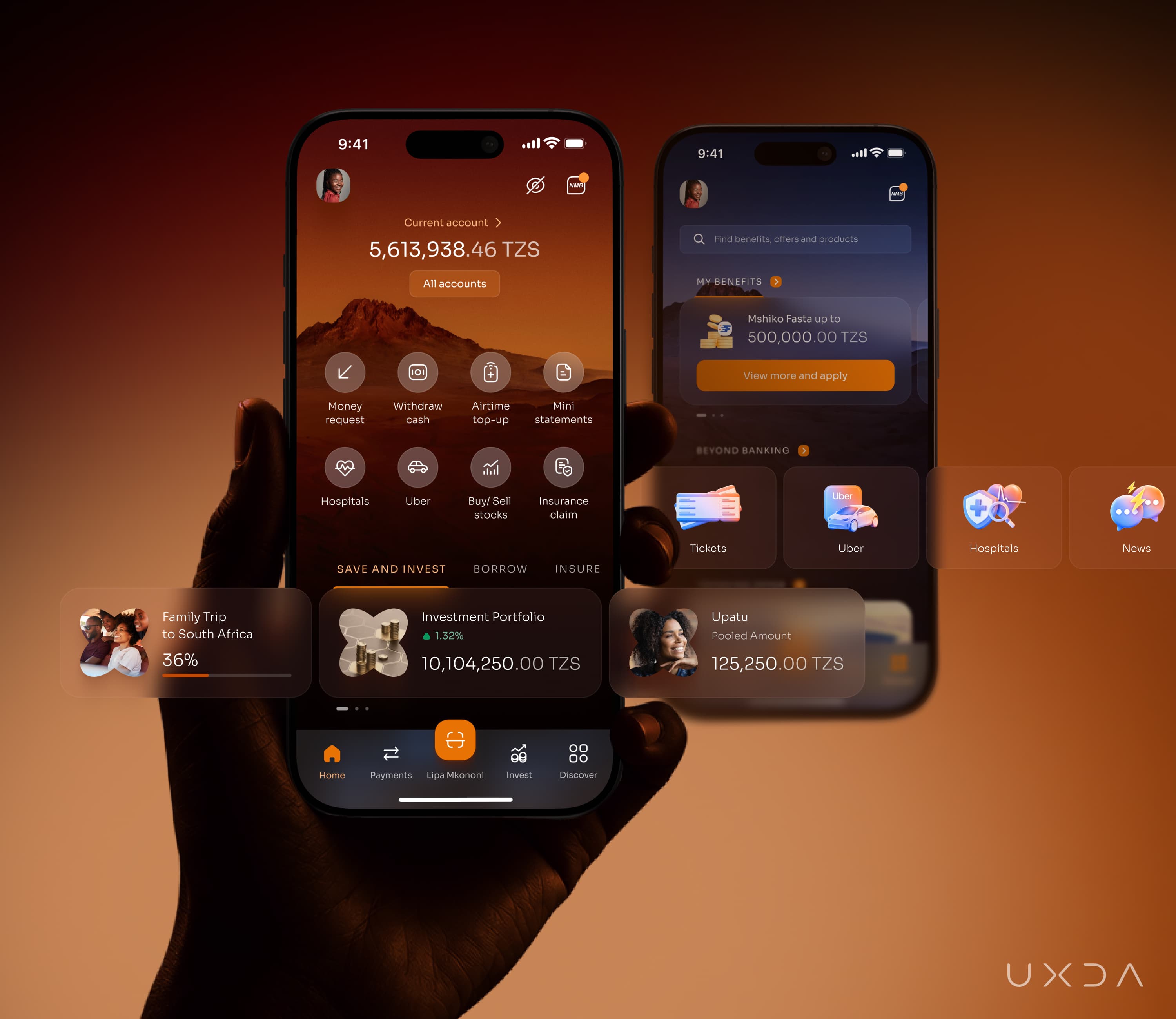
The same thinking reached beyond the phone. Corporate internet banking on the desktop followed the same experience principles through a modular, role-based dashboard, with consolidated accounts, payment management, cash-flow analysis and pending actions. It isn’t just a copy of the retail app, but a consistent NMB experience adapted to the distinct needs of business customers.
NMB came away with more than a vision of its future Super App: a clearly prioritized first release, a scalable foundation connecting retail and corporate banking and an experience system designed to support future services without repeatedly starting from scratch. The goal was a seamless integration with each step designed to make the next one easier.
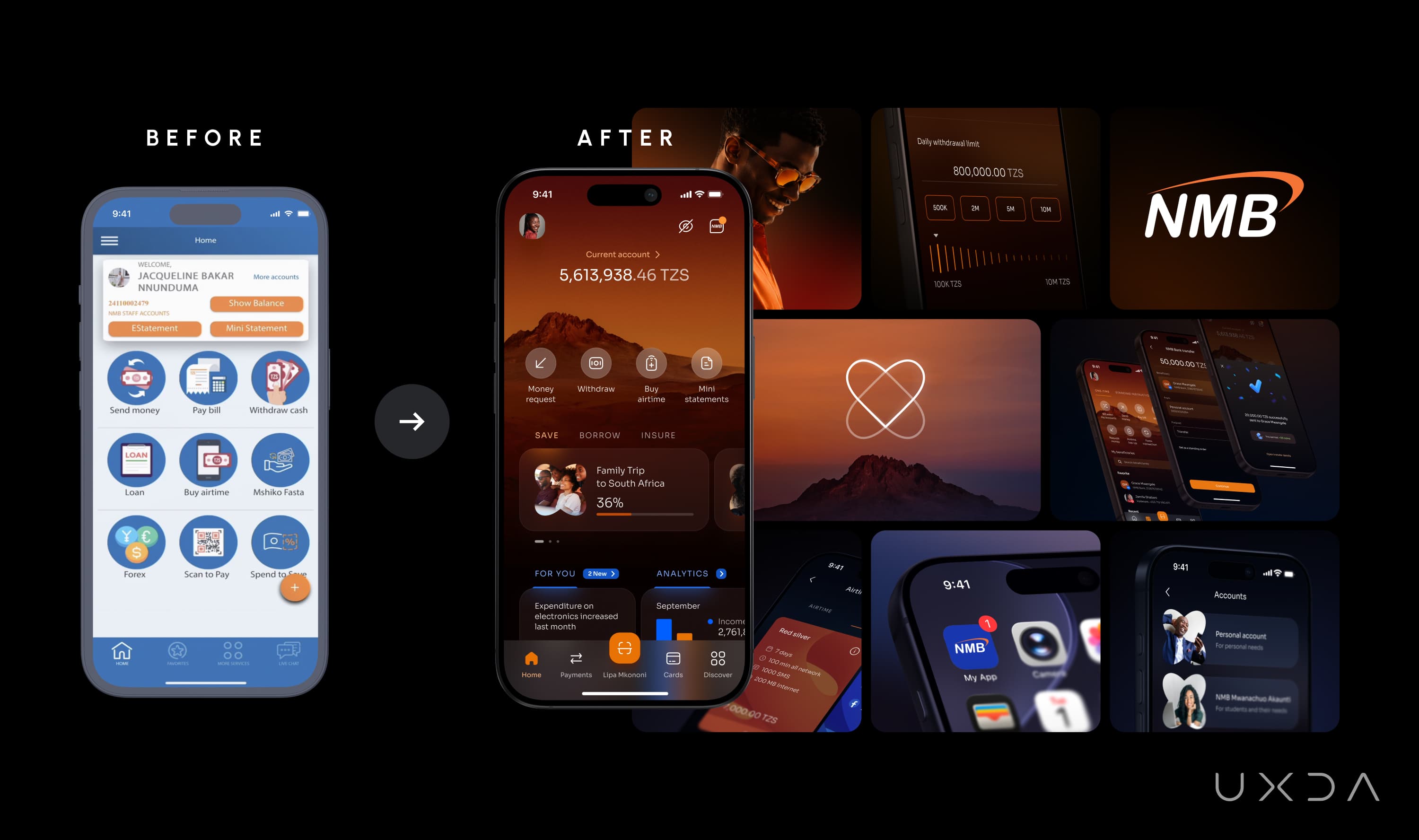
UXDA’s work with NMB concluded in 2024. On June 16, 2026, NMB launched the new Mkononi Super App, and it has kept releasing updates since then. The launch marked an important milestone in NMB's longer-term digital transformation, with the bank continuing to develop the platform through its internal teams.
Approach: Aligning Digital Strategy, Banking Teams and UX Governance
A banking Super App transformation requires more than just design expertise. It requires shared decisions across business strategy, customer experience, brand, technology and operations. UXDA worked with NMB's stakeholders to translate strategic ambitions into concrete experience requirements, which clarify dependencies and establish principles that could guide future development.
The collaboration connected NMB's local banking expertise with UXDA's global financial UX perspective. It helped align product priorities, design decisions and organizational capabilities before they became costly implementation commitments.
That logic had to be in place before the first screen. NMB’s Super App ambition needed more than a vision; it needed a clear direction to guide priorities, decisions and execution. UXDA helped turn this ambition into a strategic UX North Star and a plan connecting the first release to the long-term Super App vision.
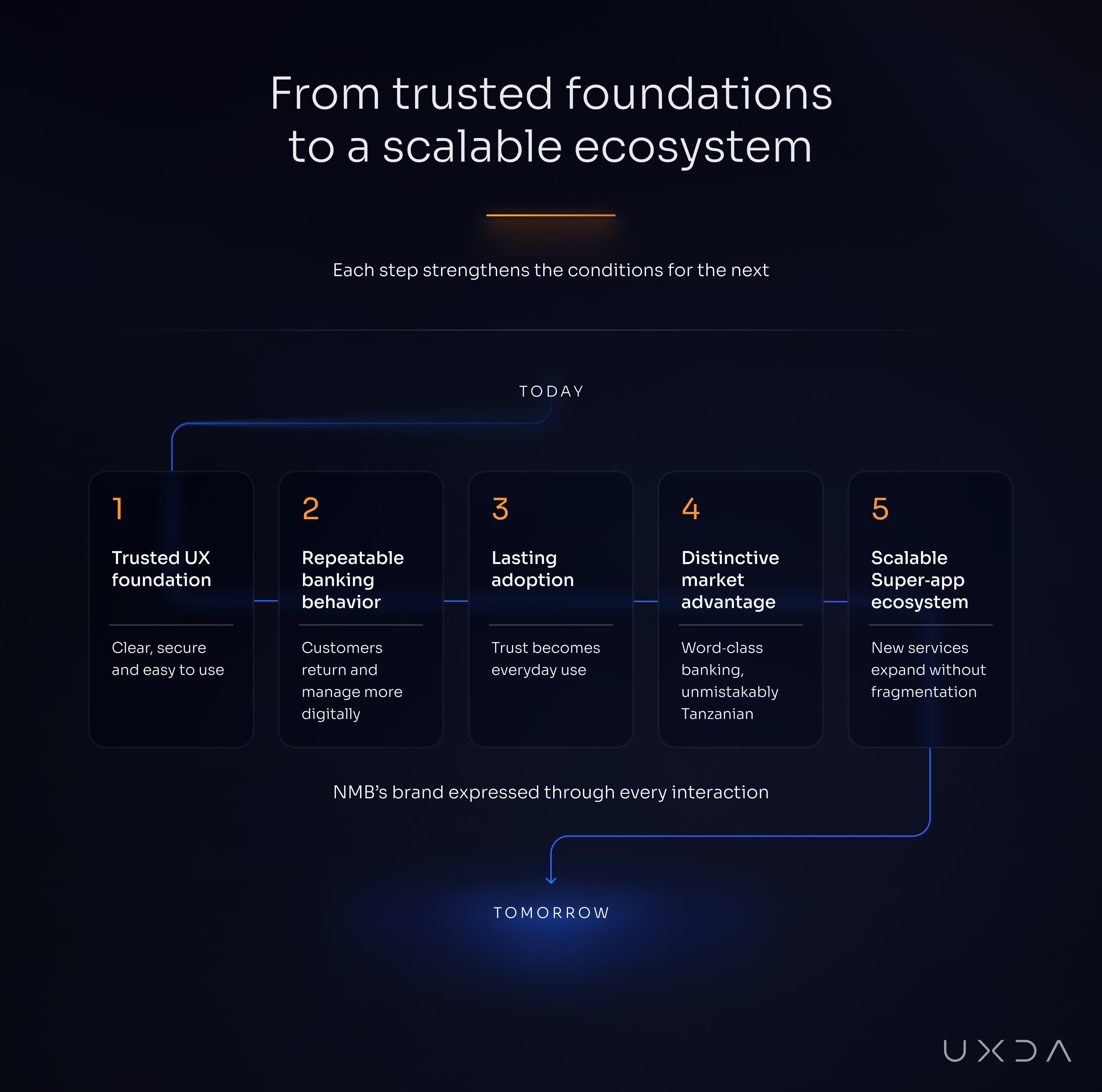
Holding to that plan required shared experience governance across NMB and UXDA. It kept global banking expertise grounded in Tanzanian lives, adapted as the scope evolved and kept new services from weakening the banking core. Each capability was tied to the development work and internal processes it depended on, reaching customers only when both were ready.
Knowledge sharing and direct involvement of the teams responsible for delivering and maintaining Mkononi helped make the strategy more understandable, actionable and sustainable beyond the initial engagement.
Building a Shared Language Before Building the Product
Big transformations often fail in a surprisingly ordinary way: everyone agrees in the meeting but then leaves with a different picture of what should be built.
UXDA works from Riga, in Northern Europe. NMB brought the reality of Tanzania: its people, market pressures and operations. Global UX expertise could only create value if it translated into that reality, not simply handed over. So alignment among teams had to be part of how the work happened every day.
Instead of relying solely on endless documentation and formal handovers, the teams worked through frequent calls, live walkthroughs and shared visual references. Ideas became visible before they became specifications, so assumptions surfaced and misunderstandings were resolved while decisions were still open. A transformation of this scale changes how an organization works. A product can move only as far as the organization behind it is ready to follow.
The diagnosis looked beyond the existing app to assess customer needs, competitive positioning and NMB's ability to deliver and sustain the experience. Five gaps gave the joint team a common framework to evaluate risks, weigh findings, discuss trade-offs and decide what was realistic:
- Adoption examined whether the experience could change behavior and earn repeat use.
- Trust focused on customer confidence in critical financial moments, whether they would actually be ready to start managing money digitally.
- Advantage tested whether Mkononi gave people a meaningful reason to choose NMB.
- Brand ensured that NMB’s identity shaped how the product behaved and not only how it looked.
- Alignment addressed whether the organization could make, deliver and extend those decisions coherently.
A Super App isn’t just a bigger product to launch; it’s a bigger product to own. UXDA involved the people responsible for developing and maintaining Mkononi from the start, so NMB’s team understood the reasoning behind every decision and shared ownership of the strategy. NMB went a step further, requesting dedicated knowledge-sharing sessions to bring UXDA's expertise closer to its internal teams. That strengthened NMB's ability to apply the established principles, keep the experience consistent and evolve the product independently. Expertise creates lasting value only when it becomes internal capability.
Bringing the Right Owners into Every Decision
The people who would own the consequences of each decision were in the room while the decisions were made.
That’s one of the most effective ways to prevent costly rework. Problems caught in a design discussion cost a conversation. Caught in development, they cost rework. Caught by customers, they cost trust. NMB understood this, which is what made the bank such a strong partner. A highly engaged, cross-departmental team brought business owners and decision-makers straight into product discussions, so dependencies, conflicting requirements and technical limits could be addressed before they became development obstacles.
Every Mkononi flow was shaped by the department that owned it. The lending team brought the full business and operational context for loans. The payments team shaped the payment flows. Marketing worked side by side with UXDA for three weeks to refine visual concepts that would resonate with Tanzanian customers. Technology specialists clarified what could be built and sustained. Each team knew its rules and constraints, and each was invested in getting the best result for its area.
UXDA brought the customer perspective and global financial UX expertise to connect these departmental perspectives into one coherent experience, balancing customer needs with business priorities and delivery realities. Responsibilities were clear and revisited whenever needed, but the commitment to the result was shared, and it showed in every meeting.
The transformation also created space for conversations that normal daily operations rarely leave time for. Teams learned what mattered to other departments, why certain constraints existed and how one local decision affected the whole banking experience.
Design does more than shape a product. It connects people inside a company and, through the product, connects the company with its customers. For leaders, the lesson is direct: customers experience the organization behind the interface, whether its teams work as one or in silos.
Financial UX Research: Grounding Global Expertise in Tanzanian Lives
People may lose loyalty to individual brands, but they stay loyal to the way they live.
Working from the other side of the world made deep immersion essential. An outside view can spot patterns insiders no longer notice, but without rigorous research it can just as easily bring in bias. As Naoto Fukasawa, world-renowned Japanese industrial designer, put it, “Great design is a multi-layered relationship between human life and its environment.”
A successful banking experience cannot be created by transferring international UX patterns into a new market without understanding local customer behavior. For the NMB engagement, UXDA combined global financial UX expertise with NMB's local operational knowledge, stakeholder interviews, customer personas and research into Tanzania's financial habits and digital banking environment.
Research became the team’s way of traveling to Tanzania from a distance, with the advantage of slowing down to notice details and uncover the real “why” behind each answer. Global best practices were treated as hypotheses to test against Tanzanian behaviors, needs and constraints, not ready-made solutions to adopt without tailoring.
The first “why” was control over money. With cash and mobile money, the money felt tangible, each task followed a straight line, and it was obvious when it was done. With USSD transactions, a payment disappears the moment it’s sent: one text message, with no way to track it, check its status or look it up later. A habit built over years doesn’t change because an app looks better. It changes when the new way feels just as safe as the old one, and it’s a little easier every time. In Mkononi, every payment stays visible and in the customer’s control.
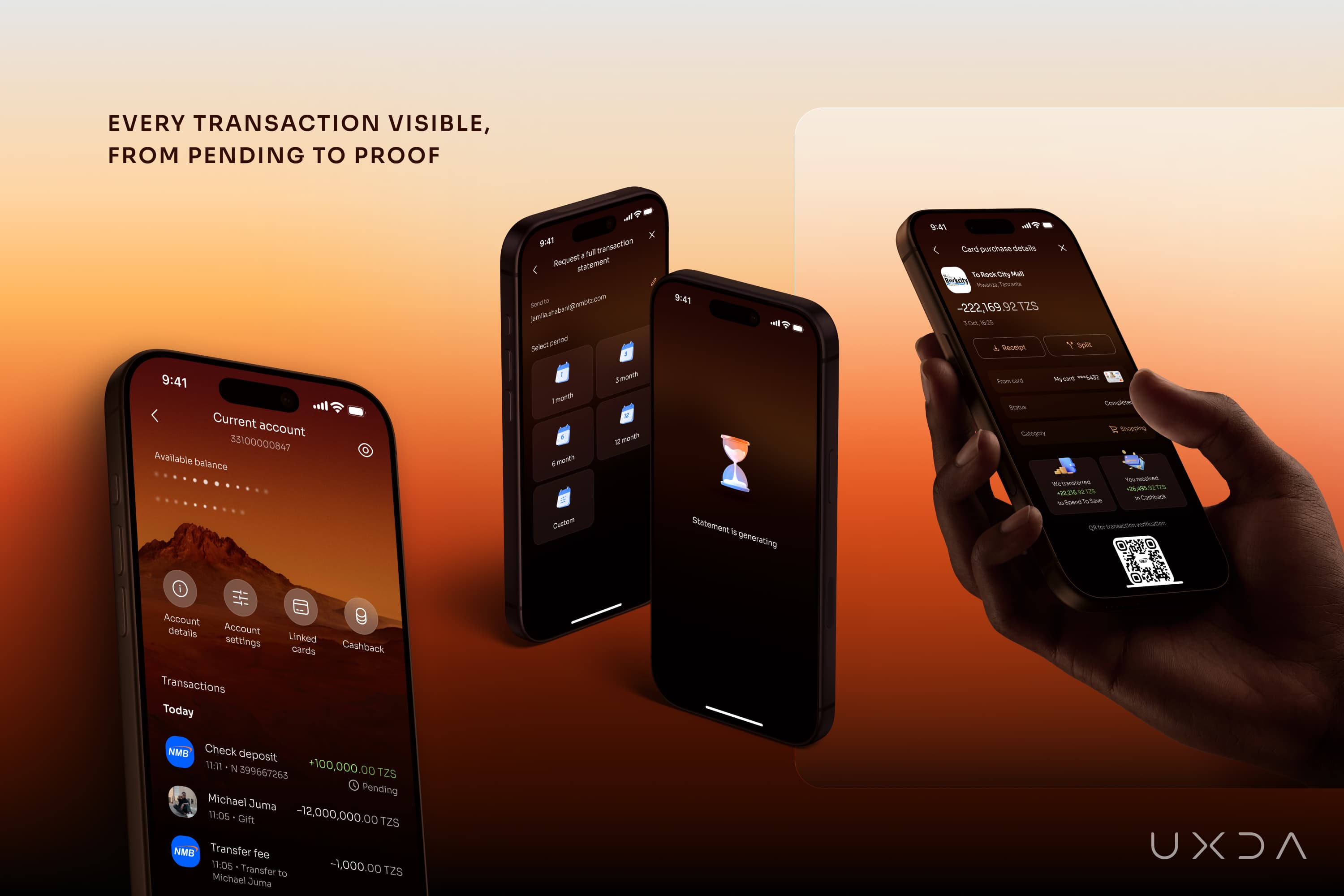
The second was safety. By 2022, about 35 million Tanzanians used mobile money, and “send to this number” scams had become a daily nuisance, even after biometric SIM registration became mandatory. So Mkononi was designed to build confidence step by step: familiarity → clarity → successful repetition → confidence → new behavior. Every part of it is something customers already recognize, can check or can recover from:
- Reassurance → familiar ground. Mkononi kept the services customers already used, many still available by USSD.
- Clarity → one sequence everywhere. Every payment and transfer follows the same steps: select, review, confirm, receive proof. Customers see who gets the money before it moves.
- Certainty → money that stays visible. Live status, receipts and a full history follow every payment.
- Recovery → a way forward. If something fails, there’s always another route, from a PIN instead of a selfie to a callback from an advisor.
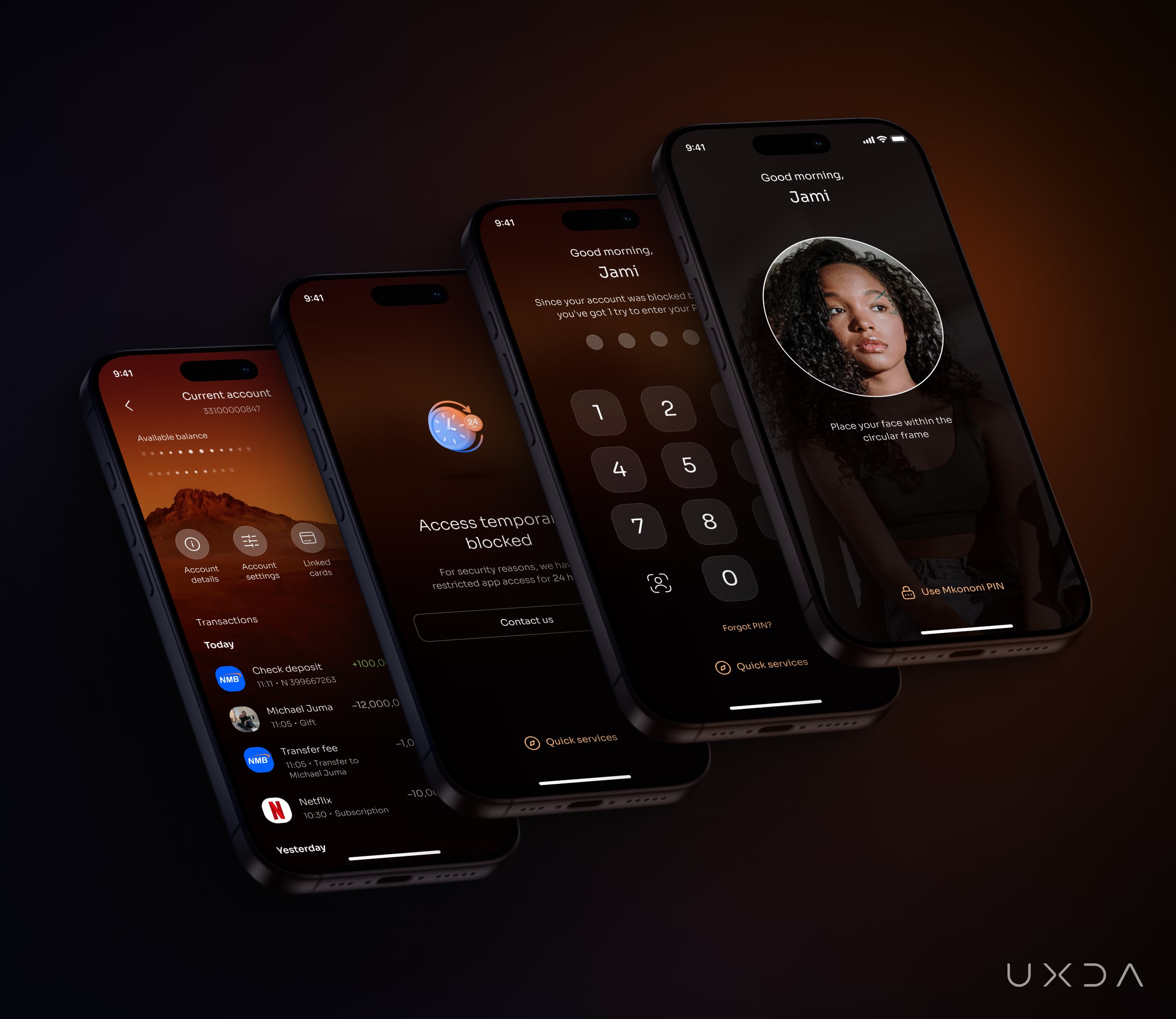
Consistency is what makes this work. Confidence earned in one successful payment carries into the next, until the app feels predictable without effort. It’s also a commercial advantage, not just a design detail. McKinsey found that 30% of customers trust banks with the most consistent experiences over banks with the least consistent ones. Getting these experiences right can also raise revenue by up to 15% and cut the cost of serving customers by up to 20%. For NMB, each predictable transaction is one less reason for a customer to cash out.
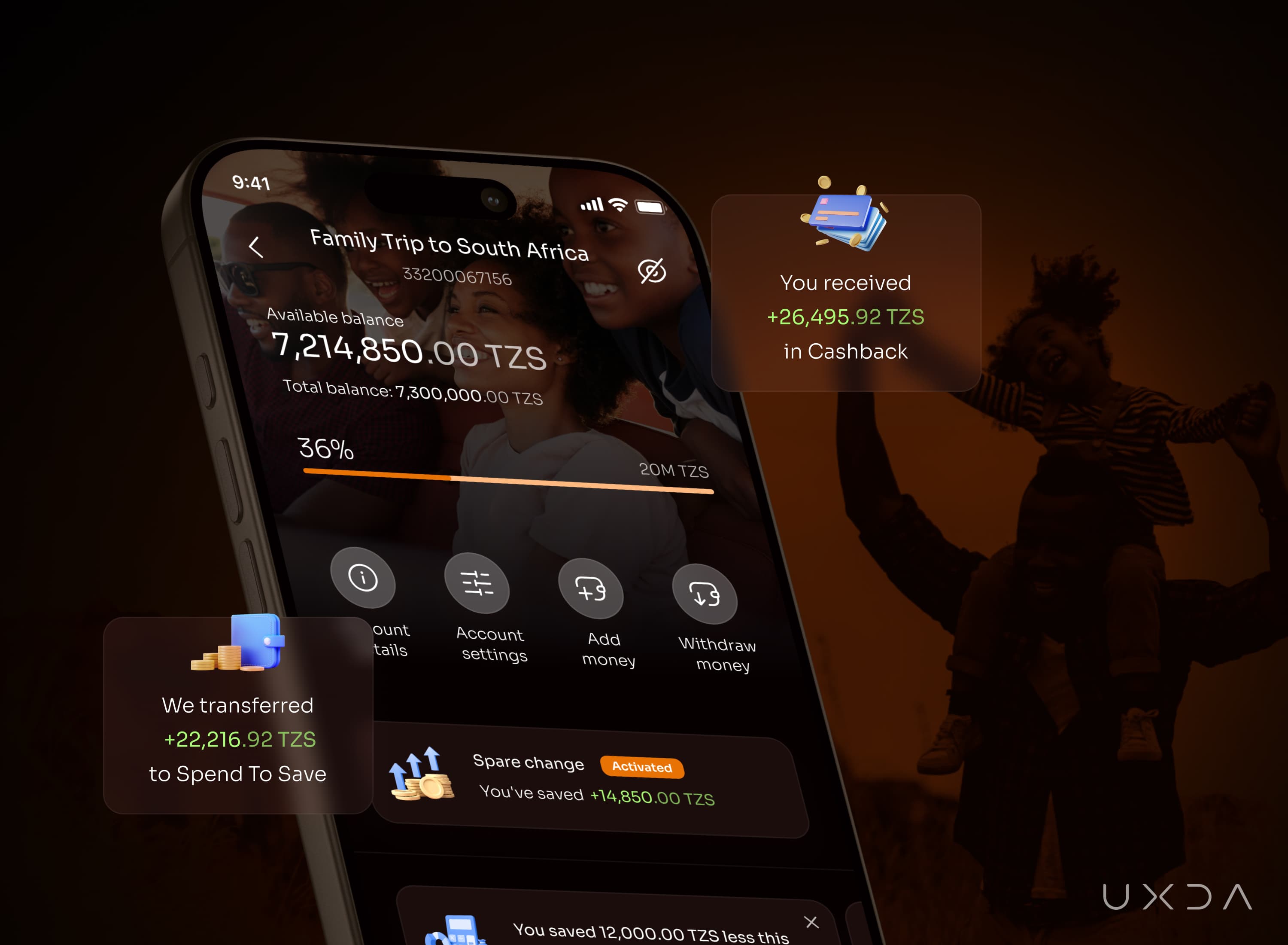
The third was purpose. In one FSDT study, a savings-group member measured financial progress not by her balance, but by buying her own land and building the brick house she had long dreamed of. A savings goal could mean security, a business, education or a new stage of life. Something that looks small on a screen can mark a turning point for a family. This shaped Mkononi’s goal-based savings: named goals and visible progress connected savings to a real purpose. The same thinking applied to loans, presented as a step toward a goal customers want to achieve rather than just a debt. For NMB, connecting financial products to meaningful goals created opportunities for increased engagement and stronger long-term customer relationships.
 Global scale doesn’t come from erasing local differences. It comes from building a system strong enough to turn them into adoption, trust and a competitive advantage.
Building an Ecosystem the Business can Grow Into
A product that can’t scale becomes a problem at exactly the wrong moment: when the business is growing.
A digital banking product never stands alone. It connects the brand customers recognize, the channels where they meet it, the service they receive, the technology underneath and the partners who may join later. Treating all of that as one system sounds obvious, but for a bank, it’s a major shift in how it operates. For NMB, it meant designing Mkononi not as a standalone app or a one-off release, but as the customer-facing foundation of a growing business ecosystem.
No one could predict exactly which services, partners or technologies NMB would need in five or ten years, so the team separated what had to stay stable from what had to stay flexible:
- The stable layer was how customers experience the bank: a banking-first hierarchy, predictable journeys, reusable interaction patterns and one consistent way of guiding, confirming and giving control.
- The flexible layer was what the bank offers: new financial products, partner services, beyond-banking features and new technologies, added step by step as customer demand, business priorities and technical readiness allow.
This distinction shaped both the information architecture and every journey built from it. Core financial priorities remained immediately accessible, while new services gained a clear place to grow without crowding the banking experience. Shared interaction logic connected 70 user flows and created continuity across mobile, desktop and role-based corporate banking. Customers shouldn’t have to relearn NMB when they move between personal and business banking, phone and desktop or NMB and a future partner.
This is why design had to enter at the beginning as a core strategic competence, not arrive at the end as an interface service. The team asked the difficult questions before technology and organizational dependencies became too expensive to change: What happens if the number of services doubles? Where does a new partner enter the experience? Which principles must remain consistent across every channel? What technology change can be implemented without forcing customers to relearn how NMB works?
Addressing these questions early reduces future redesign and development costs, shortens the path from a new business idea to market and protects customer trust as the offer expands. For NMB, this turned Mkononi from a redesigned application into a platform the business could continue building on.

A future-ready bank does not need to predict every service correctly. It needs an architecture and governance system strong enough to add, connect and evolve services without fragmenting the customer experience. Design is how future change becomes faster, safer and less expensive.
Takeaway: Building a Scalable Foundation and a Clear Path to Growth
UXDA's engagement translated NMB's long-term digital transformation strategy into a seamless customer experience, scalable information architecture and distinctive Digital Brand Identity. Rather than treating Mkononi as an isolated mobile application, the NMB team established a shared foundation for a broader digital banking ecosystem expansion.
The ambition of the NMB's Super App is enormous: more digital services, more partners, more reasons for customers to stay. But every new possibility also adds complexity, and it’s critical to ensure a richer experience without becoming harder to use.
For NMB, that meant building from a strong center outward:
- First make everyday banking effortless. Mkononi’s core banking journeys create the trust customers need to explore more services. Familiar actions, clear navigation and immediate feedback make the experience feel simple and dependable.
- Combine global standards with local relevance. Mkononi brings global digital banking expertise together with Tanzanian behaviors, financial needs, identity and aspirations. The result is a digital experience that feels both world class and distinctly local.
- Create a structure that can grow. New products, partner services and corporate internet banking can expand within the same experience instead of requiring the platform to be redesigned each time the ecosystem evolves.
- Turn design decisions into shared capability. NMB’s business, brand and technology teams worked alongside UXDA throughout the process, building the knowledge and alignment needed to carry the experience forward long after the initial launch.
Building a successful banking Super App is not simply about bringing more services into one application. It is about creating an experience customers can trust, understand and use confidently as their financial needs evolve.
For NMB, this meant establishing a strong banking foundation before expanding the ecosystem. UXDA connected international financial UX expertise with Tanzanian customer behaviors, NMB's distinctive brand identity and the bank's long-term strategic ambitions.
The project covered 12 retail services, five corporate services and 70 user flows, creating a structured experience foundation that NMB could build upon. The strategic and design outcomes included:
- A banking-first Super App experience strategy prioritizing trust, adoption and everyday financial utility.
- A scalable information architecture designed to accommodate current banking services and future ecosystem expansion.
- A distinctive Digital Brand Identity connecting global banking standards with NMB's values and Tanzanian cultural relevance.
- Reusable interaction and design patterns supporting consistency across products and channels.
- A coordinated retail and corporate experience direction establishing shared principles across mobile and internet banking.
- Greater organizational alignment through stakeholder collaboration, design validation and knowledge sharing.
The result was a scalable experience direction built around three priorities: make everyday banking effortless, create meaningful local differentiation and enable new services without compromising the customer experience.
Equally important: the transformation connected design decisions with the teams responsible for delivering and maintaining them. The experience was designed not only for the first release but for continuous evolution.
The strategic lesson extends beyond Tanzania: a successful banking Super App is not defined by how many services it offers, but by how confidently customers can use them — and how effectively the experience can grow without losing its simplicity, trust or identity.
That is why perhaps the most important thing UXDA designed for NMB was not a single interface or feature but a foundation strong enough to let the experience change without losing its way.
NMB Mkononi Super App: Key Questions
What is the NMB Mkononi Super App?
NMB Mkononi is a digital banking platform developed by NMB Bank in Tanzania, offering access to everyday banking services and supporting the bank's broader ambition to provide a connected financial ecosystem. In June 2026, NMB launched an upgraded Mkononi Super App as part of its continuing digital transformation.
What was UXDA's role in the NMB Mkononi Super App project?
UXDA partnered with NMB Bank in 2023–2024 to define the experience strategy, information architecture, Digital Brand Identity and scalable design foundation for Mkononi. The engagement combined international financial UX expertise with Tanzanian customer expectations, local financial behaviors and the bank's organizational capabilities.
What was the biggest UX challenge in designing NMB Mkononi?
The central challenge was balancing ambitious Super App expansion with the need for familiar, trustworthy and accessible everyday banking . UXDA focused on making essential financial journeys clear and dependable while creating an architecture capable of supporting additional products and services over time.
How did UXDA adapt global banking UX standards to the Tanzanian market?
UXDA combined established financial UX practices with research into Tanzanian financial behaviors, customer needs and cultural identity. The resulting experience prioritized clear transactions, familiar banking actions, visible feedback, local relevance and customer confidence rather than simply replicating Super App patterns from other markets.
What is the Heart of Tanzania digital banking concept?
The Heart of Tanzania is the Digital Brand Identity concept UXDA developed for NMB Mkononi. Inspired by Kilimanjaro and Tanzanian cultural identity, it connects the bank's values with a distinctive visual and interaction language intended to communicate expertise, empathy and progress.
How is the NMB Mkononi Super App organized?
UXDA established a banking-first information architecture based on three experience layers: See, Act and Grow. See prioritizes financial clarity, Act provides access to everyday banking tasks, and Grow supports financial insights, savings goals and broader service discovery. The structure is designed to make essential functions accessible while accommodating future ecosystem expansion.
How can banks design a scalable Super App experience?
A scalable banking Super App requires a clear customer experience vision, prioritized core banking journeys, flexible information architecture, reusable interaction patterns and consistent experience governance. Banks should protect essential financial tasks while introducing new services according to customer needs, commercial priorities and organizational readiness.
When did NMB launch its upgraded Mkononi Super App?
NMB launched the upgraded Mkononi Super App in June 2026. UXDA's strategic UX engagement had concluded in 2024, and the subsequent launch formed part of NMB's wider ongoing digital banking transformation.
What business value can a banking Super App UX strategy create?
A well-defined banking Super App UX strategy can support customer adoption, product engagement, service efficiency, competitive differentiation and long-term ecosystem expansion. Its actual financial contribution must be assessed through measurable indicators, such as active usage, task completion, product adoption, customer retention and cost-to-serve.
Get UXDA Research-Based White Paper "How to Win the Hearts of Digital Customers":
Is Your Digital Banking Experience Ready for What’s Next?
Building a future-ready financial experience takes more than great design. It requires a clear strategy that connects customer trust, distinctive Digital Brand Identity and scalable digital ecosystems with long-term business growth.
At UXDA, we partner with ambitious financial institutions to turn complex digital challenges into strategic opportunities — creating experiences that customers trust, brands can own and businesses can confidently scale.
Request a Private Briefing:
- E-mail us at info@theuxda.com
- Chat with us in Whatsapp
- Send a direct message to UXDA's CEO Alex Kreger on Linkedin