


In e-commerce, friction often threatens a transaction. In hospitality, poor service may ruin an occasion. In banking, a poor experience can affect a customer's financial security, future opportunities and confidence in making important life decisions. Yet many banking CX strategies are still built around principles borrowed from other industries: eliminate friction, personalize every interaction, increase engagement, accelerate conversion and make digital services effortless. These principles are useful. But applied without considering the specific nature of financial services, they can lead banks in the wrong direction.
A customer abandons an online shopping cart because checkout takes too long. A traveler switches hotels after a disappointing stay. A streaming subscriber cancels because the content no longer feels relevant. Now consider a customer struggling to understand mortgage conditions, a small business owner facing an unexpected cash-flow shortage, or a retiree making a decision about their life savings.
All these situations involve customer experience. But they are not the same kind of experience problem.
A frictionless loan application is not necessarily a good experience if customers don't understand the commitment they are making. A personalized investment recommendation is not valuable if it creates inappropriate risk. A mobile banking application that encourages constant engagement may be less useful than one that helps customers manage their money confidently in seconds.
This is the fundamental challenge of customer experience strategy in banking. Banks must design not only for convenience and satisfaction, but for financial confidence, informed decisions, long-term relationships and institutional trust.
At UXDA, a decade of working exclusively with financial institutions has demonstrated that banking CX cannot be approached simply as another branch of general service design. The combination of financial responsibility, customer psychology, regulation, legacy infrastructure and long-term relationships creates a fundamentally different strategic challenge.
And this difference is where the greatest opportunity for competitive advantage in banking begins.
What Makes Customer Experience Strategy in Banking Different
Unlike traditional customer experience strategies focused primarily on convenience, engagement and satisfaction, banking CX strategies must also address financial trust, risk, regulatory obligations, informed decision-making and lifelong customer relationships. Banks therefore need a different CX approach that balances effortless interactions with responsible financial decisions, institutional consistency and long-term customer value.
Customer experience strategy in banking is the coordinated approach financial institutions use to manage how customers understand, access, use and benefit from financial services throughout their relationship with the bank.
Banking CX vs. Traditional CX: 8 Fundamental Differences
| CX dimension | Typical consumer-service approach | Banking-specific reality |
|---|---|---|
| Customer goal | Complete a purchase or enjoy a service | Protect, manage and grow financial resources |
| Relationship | Often transactional or subscription-based | Continuous, interconnected and potentially lifelong |
| Decision consequences | Frequently limited or reversible | Can involve debt, financial loss or long-term commitments |
| Trust | Built through quality, reliability and reputation | Also depends on security, financial integrity and responsible advice |
| Friction | Usually something to minimize | Sometimes essential for security, comprehension and informed consent |
| Personalization | Increase relevance, engagement and conversion | Support financial appropriateness, transparency and customer well-being |
| Success metrics | Conversion, satisfaction, engagement and repeat purchases | Also financial confidence, relationship health, appropriate outcomes and risk |
| Delivery model | Often centered on a product or service journey | Complex coordination of products, channels, core systems, risk and compliance |
These distinctions have significant implications. The right banking CX strategy is not necessarily the one that produces the fewest clicks, the most frequent interactions or the fastest commercial conversion.
It is the one that creates the greatest sustainable value for customers and the financial institution—without compromising trust, safety or financial responsibility.
This requires a different playbook.
10 Customer Experience Strategies Specifically for Banking
The following principles address how financial institutions should adapt conventional CX practices to the unique nature of banking.
1. From Customer Satisfaction to Financial Confidence
In banking, the most pleasant experience is not always the most valuable one.
In many consumer industries, customer satisfaction is strongly associated with convenience, positive emotions, excellent service and successful transactions.
Banking customers also value these qualities. But financial services introduce another dimension: customers need confidence that they are making the right decisions about their money.
Consider a customer comparing mortgage offers. A beautifully designed interface and an application completed in five minutes may deliver excellent usability. But if the customer does not understand how interest-rate changes could affect future repayments, the experience has failed at a more fundamental level.
The interaction may be effortless while the financial decision remains uncertain. This distinction matters because a bank's responsibility does not end when the customer successfully completes a journey. The financial consequences may continue for years.
Research from Gartner on digital banking and financial well-being reinforces this perspective. Gartner argues that financial institutions need to evolve beyond digital self-service for everyday transactions and support customers navigating significant life events, unexpected situations and broader financial goals.
For banking leaders, this means customer experience must be evaluated not only by how customers feel during an interaction, but by whether the interaction improves their understanding and ability to make an informed decision.
Conventional CX question: How satisfied was the customer with the interaction?
VS
Banking CX question: Did the interaction help the customer understand their financial situation, make an informed decision and feel confident about what happens next?
What this means for banking strategy: Build financial comprehension, confidence and decision-support principles into onboarding, lending, savings, investments and financial guidance. Measure informed understanding alongside ease, completion and satisfaction.
What this means for experience architecture: Design experiences that reveal the financial implications of decisions through clear language, comparisons, simulations and contextual explanations—not just attractive interfaces and simplified forms.
2. From Frictionless Experiences to Responsible Friction
The best banking experience is not always the fastest.
Across e-commerce and consumer technology, reducing friction has become a central optimization principle. Fewer steps, fewer confirmations, faster checkout and effortless transactions often improve performance.
In banking, unnecessary friction is equally damaging. Complicated onboarding, repetitive authentication, confusing forms and fragmented processes can undermine adoption and trust. But removing all friction can create new risks.
Consider three situations:
- A customer transfers a large sum to an unfamiliar recipient.
- A customer applies for a long-term loan without understanding the repayment obligations.
- A customer decides to liquidate an investment during a period of market volatility.
In each case, a brief, well-designed intervention may be more valuable than immediate execution.
The objective is not to slow customers down indiscriminately. It is to introduce the right level of protection and understanding at the right moment. Banking CX should therefore distinguish between administrative friction, which adds little value, and protective friction, which helps customers avoid errors, understand consequences or authenticate sensitive actions.
Financial regulators recognize the importance of this distinction. US interagency guidance on authentication highlights risk-management practices for protecting access to financial institution systems and customer information.
The strategic implication is clear: simplicity must not be confused with removing every moment of verification or reflection.
What this means for banking strategy: Establish risk-sensitive experience principles. Low-risk actions should be effortless. High-risk actions should introduce proportionate safeguards, explanations and appropriate confirmation.
What this means for experience architecture: Define reusable patterns for authentication, transaction review, warnings, consent, error recovery and human escalation, calibrated to different risk levels.
3. From Conversion Optimization to Responsible Financial Decisions
More sales do not automatically mean better customer experience.
In retail, conversion is often a direct measure of commercial success. Customers discover a product, evaluate its benefits and make a purchase. In banking, conversion is only the beginning of a financial commitment.
An accepted credit-card offer can lead to years of borrowing. A mortgage application can establish obligations lasting decades. An investment decision can expose customers to risks they may not fully understand.
This creates a tension between commercial objectives and customer interests. A bank may optimize a lending journey to improve application completion while unintentionally reducing customers' understanding of affordability, repayment obligations or product suitability. Such optimization can create a short-term commercial gain at the expense of longer-term customer and institutional outcomes.
The broader lesson is that banking CX cannot separate conversion design from responsible decision-making. Financial institutions should seek commercially successful journeys that also support appropriate product selection, informed consent and sustainable customer relationships.
What this means for banking strategy: Evaluate acquisition and product-sales journeys against both commercial performance and customer suitability. Where applicable, connect CX objectives with affordability, disclosure and responsible-product requirements.
What this means for experience architecture: Build eligibility explanations, product comparisons, total-cost visibility, decision-support tools and transparent next steps into financial product journeys.
A bank should not celebrate faster credit conversion without understanding whether customers are making better-informed borrowing decisions.
4. From Frequent Engagement to Meaningful Financial Relevance
Banking customers do not necessarily want to spend more time with their bank.
Many digital businesses optimize customer engagement through frequency, time spent, interaction depth and content consumption. Social platforms want customers to return repeatedly. Streaming services encourage longer sessions. E-commerce platforms stimulate browsing and discovery.
Banking works differently. Most customers do not wake up hoping to spend more time managing their bank accounts. They want to know that their money is safe, their obligations are manageable, their payments will work and their financial goals are progressing.
For routine banking, the ideal experience may involve extremely short interactions—or no interaction at all. A customer should not need to open an application repeatedly to check whether a bill can be paid safely. A business owner should not have to manually reconcile information that the institution could explain clearly and proactively.
This creates a banking-specific paradoxThe better a bank serves its customers, the less effort customers may need to spend interacting with it.
However, that does not mean reducing every interaction. When a customer is planning retirement, buying property or making a complex investment, deeper engagement becomes valuable. The strategic objective is therefore not maximum engagement. It is appropriate engagement.
What this means for banking strategy: Replace generic engagement targets with a distinction between routine banking efficiency and valuable advisory interactions. Prioritize time saved, financial task completion, useful guidance and relationship health.
What this means for experience architecture: Create an experience that supports both rapid everyday actions and deeper financial exploration, without forcing one interaction model onto every customer need.
5. From Personalization to Financial Appropriateness
Knowing what customers might buy is different from knowing what they should consider.
In e-commerce, personalization often means recommending products based on browsing history, previous purchases, similarities between customers and predicted preferences. In banking, personalization has much greater consequences.
A bank may know a customer's salary, spending patterns, liabilities, savings, investments and financial commitments. This information creates opportunities to provide highly relevant financial support. But it also creates responsibilities concerning privacy, fairness, consent and the appropriate use of customer data.
A customer who frequently spends on travel might benefit from a suitable travel-related card. But a customer whose spending indicates financial stress may need budgeting support rather than another credit offer. Similarly, a personalized investment recommendation must account for more than predicted interest. Where investment suitability obligations apply, it must reflect relevant financial circumstances and risk considerations.
McKinsey's Global Banking Annual Review 2025 highlights the movement toward increasingly individualized banking experiences, with mobile and AI reshaping how institutions serve customers. But the competitive opportunity is not personalization for its own sake. It is making the institution more helpful, relevant and responsible in the context of each customer's financial life.
What this means for banking strategy: Define personalization according to customer value, not merely commercial propensity. Establish clear rules for consent, data use, transparency, fairness and appropriate recommendations.
What this means for experience architecture: Integrate customer context, lifecycle events, permissions and explainable recommendation logic across relevant financial products and channels.
6. From Customer Journeys to Lifelong Financial Relationships
Banking CX must connect decisions made years apart.
Many conventional CX methodologies organize experiences into individual journeys: discover, purchase, use, receive support and repurchase. This journey-based approach is valuable in banking, but financial relationships rarely follow a simple linear pattern.
A customer may open their first account as a student, receive a salary years later, apply for a mortgage, start a business, invest for retirement and eventually manage inherited wealth. These experiences may occur across decades and multiple product categories. They are interconnected through the customer's financial life, even when the bank manages them as separate business lines.
Consider how a customer's mortgage affordability depends on income, existing liabilities, spending patterns and financial commitments. Or how a small business owner's financing requirements relate to payments, cash flow, seasonal revenue and future growth plans.
When banks design every product as an isolated journey, they fail to use the broader relationship context. A successful banking CX strategy must therefore connect three dimensions: individual journeys, ongoing financial relationships and significant life events.
This is where UXDA's Bank-as-a-Product concept becomes strategically important. Instead of approaching banking as a portfolio of disconnected digital products, the institution should design a coherent ecosystem that supports customers throughout their financial lifecycle.
What this means for banking strategy: Organize CX priorities around customer relationships and financial life events, not solely departmental product portfolios.
What this means for experience architecture: Establish shared customer context, consistent product logic, reusable components and cross-product information structures that enable continuity across accounts, payments, lending, wealth and other services.
7. From Omnichannel Convenience to Institutional Continuity
Switching channels in banking must not mean losing financial context.
For a retailer, omnichannel experience might mean starting a purchase online and collecting it in a store. In banking, channel continuity often involves far more complex processes.
A customer may begin a loan application digitally, need help from a relationship manager, submit additional verification documents and later receive a decision through another channel. The journey can involve personal data, financial eligibility, risk assessment, regulatory checks and multiple internal systems.
A disruption is therefore not merely inconvenient. It can require customers to repeat sensitive information, increase uncertainty or delay important financial decisions. This makes omnichannel banking as much an architectural and organizational challenge as a design challenge.
A visually consistent interface cannot compensate for disconnected customer records, incompatible workflows or contradictory product information. The opportunity extends beyond traditional channels.
As AI assistants become more capable, they must also operate within the same institutional logic and customer context as the bank's other services.
What this means for banking strategy: Define continuity as a fundamental service promise. Hold business functions, technology teams and vendors accountable for coherent end-to-end experiences.
What this means for experience architecture: Develop shared journey states, context transfer, consistent terminology, service handoff patterns, permission models and common experience standards across channels.
8. From Emotional Delight to Trust Under Financial Stress
The most important banking experiences often happen when something goes wrong.
Consumer brands frequently emphasize positive emotions, memorable interactions and moments of delight. Banking must also design for anxiety, uncertainty, vulnerability and financial stress.
A customer whose card is blocked while traveling does not need a delightful animation. They need immediate understanding, reassurance and a reliable path to resolution. A customer facing a declined mortgage application needs clarity and dignity, not generic promotional messaging. A business owner experiencing a payment delay needs visibility into what happened, what can be done and when the issue will be resolved.
These moments reveal the quality of a banking relationship. A bank may spend millions communicating reliability through advertising, but a single poorly managed financial emergency can undermine that promise. This is why trust cannot be treated as a brand attribute added to the interface. It must be designed into the actual behavior of the financial institution.
At UXDA, this connects directly to Digital Brand Identity: the bank's promise must be demonstrated through the experience itself. If a bank promises to be a dependable financial partner, its digital services must behave dependably when customers are most vulnerable.
What this means for banking strategy: Prioritize critical and emotionally sensitive moments alongside high-volume journeys. Define trust standards for fraud, financial hardship, service interruptions, complaints and high-consequence decisions.
What this means for experience architecture: Design explicit recovery journeys, crisis-state communication, understandable status updates, accessible assistance and reliable escalation to human support.
9. From AI Automation to Accountable Financial Intelligence
AI in banking must support decisions, not simply accelerate interactions.
Many industries use AI to personalize content, automate service responses, generate recommendations and improve operational efficiency. Banking has similar opportunities, but the consequences of incorrect or misleading AI outputs are potentially much greater.
An AI shopping assistant recommending an unsuitable pair of shoes creates a relatively limited problem. An AI banking assistant providing inaccurate information about loan conditions, investment risks, payment instructions or financial obligations can create far more serious consequences. This changes the requirements for AI experience design.
Banking AI must be governed by the responsibilities of the financial institution. It must communicate uncertainty, distinguish between information and advice, operate within authorized boundaries and provide appropriate human escalation.
The objective should not be to make AI appear universally capable. It should be to make AI reliably useful within clearly defined financial contexts. This requires a shift from a chatbot-first approach toward what UXDA describes as human-centered AI experience: designing how intelligent systems strengthen customer relationships, financial understanding and service delivery.
What this means for banking strategy: Determine where AI can create meaningful financial value, what decisions it is authorized to support, which risks are acceptable and where human responsibility must remain explicit.
What this means for experience architecture: Establish AI interaction patterns, permission boundaries, data-use transparency, confirmation requirements, explainability, auditability and human handoff mechanisms.
The strategic differentiator is not how many AI features a bank introduces, but how reliably those capabilities create customer value within a trustworthy financial relationship.
10. From CX Optimization to Institution-Wide Experience Governance
A banking experience is only as coherent as the organization responsible for delivering it.
Many businesses manage customer experience through journey owners, service design teams, customer insights and product optimization. Large financial institutions face additional challenges because the experience is shaped by interconnected product departments, technology platforms, regulatory obligations, operational processes and external vendors.
Consider a seemingly simple mobile banking transfer. Its customer experience depends on interface design, payments infrastructure, authentication, fraud prevention, transaction limits, customer communications, data availability and exception handling. No single UX team controls all these elements.
The same applies to lending, investments, onboarding and AI-enabled interactions. This creates a fundamental banking CX problem: the institution can have strong individual teams and still deliver a fragmented overall experience.
Deloitte Digital's research on financial services customer support found that only 38% of surveyed banking and capital-markets organizations reported having a well-defined, cross-functional strategy to improve self-service. The wider implication is that customer experience quality depends on cross-functional coordination—not merely interface design excellence.
This is why UXDA advocates Digital Experience Governance (DXG). The purpose of DXG is to establish the experience principles, standards and governance needed to align teams, products, channels and vendors while protecting the value of digital transformation over time.
For banking, it is a practical requirement for delivering one coherent financial institution through a complex digital ecosystem.
What this means for banking strategy: Establish executive ownership of the institution's experience direction and define cross-functional decision rights. Align customer experience objectives with commercial, technology, risk and operational priorities.
What this means for experience architecture: Develop shared experience standards, governance processes, design systems, service architecture and quality controls that extend across the institution's entire digital ecosystem.
UXDA's Approach: Five Gaps That Prevent Banks From Delivering Distinctive CX
These ten strategies reveal a critical distinction. In most industries, CX improvement is primarily concerned with making the customer journey more convenient, engaging and satisfying.
In banking, the experience must also remain financially responsible, understandable, trustworthy and coherent across an unusually complex institutional ecosystem. This makes isolated journey optimization insufficient.
A bank may improve transaction speed while undermining confidence. Increase product conversion while reducing informed understanding. Introduce personalization while creating privacy concerns. Improve mobile usability while leaving service processes fragmented.
The underlying problem is systemic.
UXDA's Five-Gap Framework helps diagnose the strategic weaknesses behind these outcomes:
| UXDA gap | Banking-specific diagnostic question | Typical strategic consequence |
|---|---|---|
| Adoption | Can customers confidently use the bank's services across different financial needs and abilities? | High digital investment but limited usage or reliance on assisted service |
| Trust | Does the experience reduce financial uncertainty and support responsible decisions? | Anxiety, dissatisfaction, complaints and weaker relationships |
| Advantage | Does the bank offer financial value customers cannot easily obtain elsewhere? | Generic propositions and competition primarily on rates or price |
| Brand | Does the bank's digital behavior demonstrate its positioning and promises? | A disconnect between institutional reputation and actual experience |
| Alignment | Can products, risk, technology, channels and vendors deliver one coherent experience? | Fragmentation, repeated work and inconsistent CX quality |
The framework is particularly relevant because banking CX problems rarely exist in isolation.
For example, an institution may invest in a sophisticated AI-powered financial advisor to create competitive differentiation. But if customers do not trust its recommendations, the Trust Gap prevents adoption.
If the AI assistant cannot access consistent information across products, the Alignment Gap undermines its usefulness. If the experience does not reflect the institution's positioning, the Brand Gap remains unresolved. And if the assistant offers the same generic functionality as competitors, the Advantage Gap persists.
Technology alone cannot close these gaps. The strategic priority is to identify which combination of customer, business and organizational weaknesses prevents the bank from delivering distinctive financial value.
What Banking-Specific CX Strategy Means for Executives, Strategists and Architects
Successful banking CX transformation requires different levels of responsibility to work toward the same experience direction.
For Banking Executives: Make CX a Strategic Business Capability
Banking executives must determine what kind of financial relationship the institution wants to build and how customer experience will create competitive advantage.
This means moving beyond approving digital initiatives toward establishing shared experience priorities, investment criteria and institutional accountability.
For CX Strategists: Design for Financial Outcomes, Not Just Journey Performance
CX strategists must integrate financial behavior, customer vulnerability, product suitability, life events and relationship continuity into their research and strategic models.
The goal is not merely to remove pain points, but to define which experiences strengthen customers' financial confidence and preference for the institution.
For Experience Architects: Build Coherence Across Financial Complexity
Experience architects must translate strategic principles into scalable structures connecting products, journeys, customer context, authentication, service behavior and channels.
Their responsibility extends beyond navigation and interface logic to helping the institution deliver a predictable, trustworthy experience across complex financial interactions.
These responsibilities cannot be separated. An executive strategy without architectural coherence becomes an aspiration. An elegant experience architecture without customer research becomes a technical structure in search of relevance. And a customer-centered journey strategy without institutional governance becomes vulnerable to fragmentation. The competitive advantage emerges when all three operate as one system.
How Banking CX Strategy Changes Across Financial Business Models
Even within financial services, there is no universal CX playbook. A retail bank, wealth manager, SME bank and Islamic financial institution may share foundational experience principles while requiring very different strategic priorities.
| Banking segment | Distinctive CX challenge | Strategic focus |
|---|---|---|
| Retail banking | High-frequency transactions combined with occasional high-stakes decisions | Everyday simplicity, financial confidence and lifecycle relevance |
| SME and business banking | Multi-user roles, cash-flow dependency and operational urgency | Control, predictability, visibility and decision efficiency |
| Corporate banking | Complex service relationships, approvals and high-value transactions | Transparency, relationship continuity and process reliability |
| Wealth management | Uncertainty, sophisticated decisions and long-term financial objectives | Trust, advisory quality, contextual understanding and human connection |
| Islamic banking | Product structures, terminology and principles of Sharia compliance | Financial clarity, contextual relevance and trust in product structure |
| Digital-first banking | Limited physical relationships and strong dependence on digital touchpoints | Digital trust, differentiated value and effective service recovery |
This is why adapting generic customer experience frameworks is not enough.
A wealth management platform should not be evaluated by the same engagement assumptions as a retail payments app. A business banking dashboard should not inherit interaction models designed for individual retail customers without accounting for authorization structures and financial responsibilities. An Islamic banking experience should not simply apply conventional lending terminology to products governed by different contractual and financial principles.
Meaningful customer centricity begins by understanding the nature of the financial relationship—not just the demographic profile of the customer.
Banking CX Transformation in Practice: Three Different Strategic Challenges
UXDA's financial experience work illustrates why banking CX strategy must adapt to the actual financial context rather than follow a standardized journey-improvement formula.
These examples illustrate three distinct CX transformation challenges: institutional coherence, financial accessibility and responsible acquisition. They require different solutions, but the same underlying principle: banking customer experience must be designed around the financial reality of the customer and the strategic direction of the institution.
Emirates NBD: When Customer Experience Must Unite a Complex Banking Ecosystem
A large established bank faces a challenge that a single-product digital business rarely encounters: maintaining a coherent customer experience across multiple financial services, digital platforms, departments and customer segments.
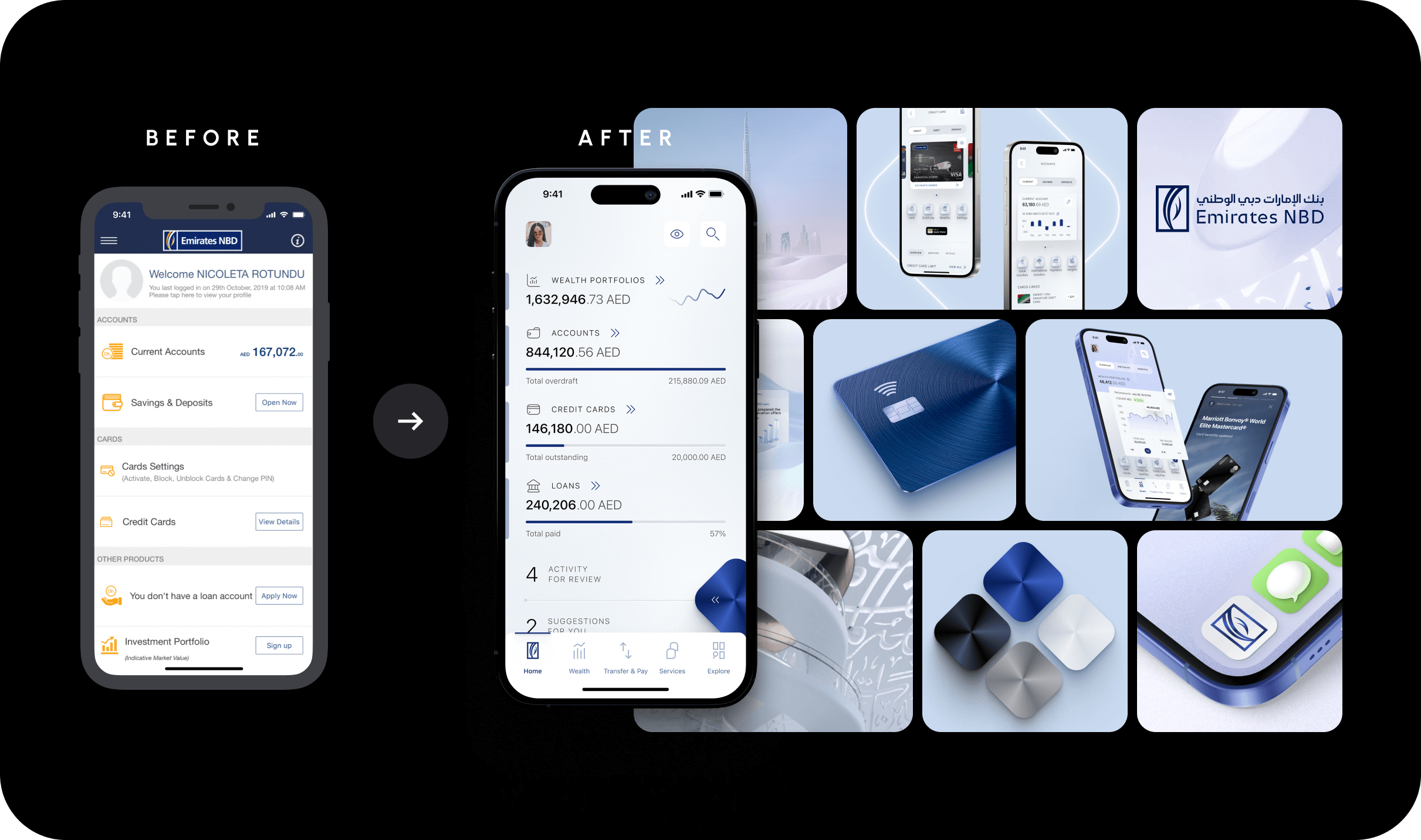
The strategic opportunity in UXDA's work with Emirates NBD was to connect digital transformation with a distinctive Digital Brand Identity and coherent experience direction.
This addresses an institutional problem, not simply a usability challenge.
As banking products evolve, the customer should continue to recognize the same financial institution through its service behavior, interaction principles and experience quality.
Banking-specific CX lesson: For established financial institutions, CX differentiation depends as much on ecosystem alignment and governance as on the quality of individual applications.
NMB Bank: When a Super App Must Bridge Different Levels of Financial Experience
For NMB Bank, transforming Mkononi into a banking super app involved a different strategic context. Customers in Tanzania are familiar with mobile money, but experience with traditional banking products and digital financial services varies considerably.

The challenge was not simply to aggregate financial functions within one financial super app. It was to create an experience that helps customers move confidently from familiar everyday financial behaviors to broader banking capabilities.
UXDA approached this through accessible everyday banking, local contextual relevance, scalable experience architecture and alignment between business and product stakeholders.
Banking-specific CX lesson: A financial super app succeeds when it creates a trustworthy progression of financial capabilities—not when it simply accumulates more services.
Garanti BBVA Securities: When Investment Experience Must Balance Simplicity With Financial Sophistication
For Garanti BBVA Securities, one of Turkey's leading brokerage firms, the strategic challenge was to transform its eTrader platform from a restrictive white-label solution into a distinctive investment experience serving both novice and experienced investors.
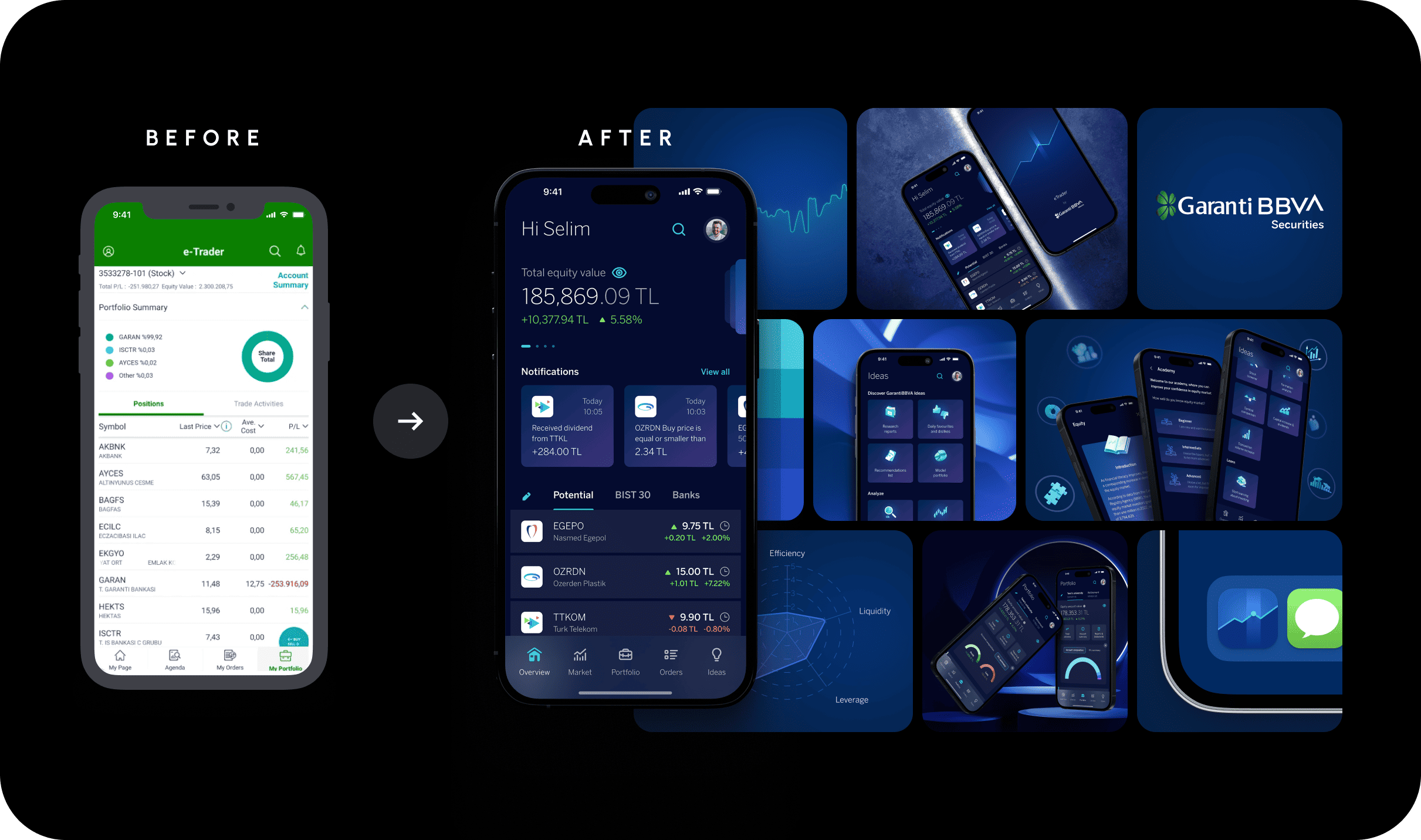
Unlike conventional digital products, where simplifying interactions often means reducing information, investment platforms must balance ease of use with access to complex financial data, analytical tools and informed decision-making.
As Garanti BBVA Securities' strategic UX partner, UXDA helped redefine the investing experience through research-driven information architecture, personalized dashboards, advanced portfolio analytics and tailored financial education. The transformation also established a consistent Digital Brand Identity across mobile, web and tablet platforms, strengthening differentiation and customer trust.
The result was a unified investment ecosystem that makes sophisticated financial functionality more accessible without compromising the depth and control experienced investors require.
Banking-specific CX lesson: Great investment experiences don't simply reduce complexity. They make financial complexity understandable, relevant and actionable for investors with different needs and levels of expertise.
How to Measure CX Success Differently in Banking
Traditional CX metrics remain relevant to financial institutions. Customer Satisfaction (CSAT), Net Promoter Score (NPS), Customer Effort Score (CES) and journey completion rates provide valuable information. But in banking, these indicators must be interpreted alongside financial outcomes, risk, trust and long-term relationship quality.
| Conventional CX measurement | Banking-specific extension |
|---|---|
| Conversion rate | Conversion quality, appropriate product selection and early product performance |
| Engagement frequency | Financial task efficiency, useful engagement and active relationship value |
| Customer satisfaction | Financial confidence, transparency and perceived trustworthiness |
| Journey completion | Successful execution, informed understanding and recovery from exceptions |
| Personalization performance | Relevance, appropriateness, consent and customer benefit |
| Digital adoption | Sustained useful adoption, assisted-service dependency and accessibility |
| Retention | Relationship depth, financial well-being and long-term customer value |
For example, measuring mortgage experience solely through application completion can overlook customers who proceed without understanding their obligations. Similarly, increasing mobile banking session frequency may appear positive even when customers return repeatedly because the system has failed to communicate a transaction's status.
Banks need a balanced experience scorecard capable of distinguishing healthy engagement from avoidable effort and sustainable growth from short-term conversion. This does not mean that banks should attempt to measure or guarantee every customer's financial outcomes. Many outcomes depend on markets, personal circumstances and decisions beyond the bank's control. It means that CX performance should be evaluated against the specific responsibilities and value proposition of financial services.
The Next Competitive Advantage in Banking Is Not Better CX. It Is Better Financial Experience.
The financial industry has made extraordinary progress in digital service delivery. Banking applications have become faster. Transactions have become more accessible. Digital onboarding has reduced administrative work. AI is creating new possibilities for personalization, service automation and financial guidance.
Yet much of the industry continues to compete using the same digital experience conventions. The same dashboard structures. The same feature categories. The same engagement mechanics. The same promise of seamless, personalized and convenient banking.
But banking is not another digital consumption industry. Customers do not choose a bank simply to enjoy an interaction. They entrust it with their financial security, significant decisions, personal ambitions and future possibilities. This relationship demands a different understanding of customer experience.
Convenience must be balanced with responsibility. Personalization must create financial relevance. Engagement must serve meaningful customer needs. Friction must be evaluated according to risk. Omnichannel design must preserve institutional continuity. And digital transformation must be governed as one coherent financial experience.
For financial leaders, this changes the strategic question. Instead of asking how to make banking more like the world's best digital consumer experiences, they should ask: What would an exceptional financial experience look like if it were designed around the unique responsibilities, relationships and opportunities of banking?
That is where genuine differentiation begins. At UXDA, we believe financial institutions need to move beyond adopting generic experience best practices and establish their own distinctive standard of financial experience. A standard grounded in customer research, guided by a clear strategic North Star, expressed through Digital Brand Identity and sustained through Digital Experience Governance.
Not simply another banking app with better usability. Not another AI assistant with more capabilities. Not another digital transformation built around the same conventions as everyone else.
From one more to one of a kind.
Because when customers make decisions that affect their financial future, the experience should do more than work beautifully. It should help them move forward with confidence. And digital will tell the truth.
Banking Customer Experience Strategy: Frequently Asked Questions
How is customer experience in banking different from other industries?
Banking CX differs because it involves financial consequences, sensitive information, long-term obligations, regulatory responsibilities and customers' financial well-being. Unlike many transactional consumer experiences, banking must balance convenience and engagement with trust, informed decision-making, security and relationship continuity.
Why can't banks simply copy CX best practices from retail or e-commerce?
Retail and e-commerce CX methods can improve banking usability and service efficiency, but they do not fully account for financial risk, responsible product recommendations, regulatory obligations and long-term financial relationships. Banks must adapt those methods to the consequences and responsibilities of financial services.
What are the most important customer experience strategies for banks?
The most important strategies include improving financial confidence, designing responsible friction, supporting informed financial decisions, prioritizing meaningful engagement, ensuring appropriate personalization, connecting financial journeys, maintaining omnichannel continuity, building trust during stressful moments, deploying accountable AI and establishing institution-wide experience governance.
What is the difference between customer experience and financial experience?
Customer experience encompasses all interactions and perceptions associated with an institution. Financial experience focuses specifically on how those interactions help people understand, manage and improve their financial lives. Financial experience therefore places greater emphasis on confidence, responsibility, clarity, long-term relationships and the consequences of financial decisions.
How should banks balance frictionless UX with security and compliance?
Banks should remove unnecessary administrative friction while retaining proportionate safeguards for sensitive or high-risk actions. This requires risk-sensitive authentication, clear explanations, appropriate consent and transparent transaction confirmation. Security and usability should be designed together, rather than treated as competing requirements.
Who should own customer experience strategy within a bank?
Executive leadership should establish the CX ambition and accountability model, while CX strategists, experience architects, product leaders, technology, operations, risk and compliance jointly translate that direction into delivery. Digital Experience Governance provides shared standards and decision rights to coordinate the institution.
Get UXDA Research-Based White Paper "How to Win the Hearts of Digital Customers":

Is Your Digital Banking Experience Ready for What’s Next?
Building a future-ready financial experience takes more than great design. It requires a clear strategy that connects customer trust, distinctive Digital Brand Identity and scalable digital ecosystems with long-term business growth.
At UXDA, we partner with ambitious financial institutions to turn complex digital challenges into strategic opportunities — creating experiences that customers trust, brands can own and businesses can confidently scale.
Request a Private Briefing:
- E-mail us at info@theuxda.com
- Chat with us in Whatsapp
- Send a direct message to UXDA's CEO Alex Kreger on Linkedin