




Many job titles have disappeared throughout history, and the reason for that is technology. The banking industry is no exception. Digitalization in banking industry has already closed thousands of branches. Will AI replace banking jobs? In some areas, yes—but AI is more likely to transform banking jobs than simply eliminate the banking workforce. Routine, repetitive and data-heavy tasks are increasingly being automated, while demand is growing for AI engineers, data scientists, cybersecurity specialists, AI governance experts and professionals capable of combining technology with human judgment.
The scale of the transition could be significant. In 2025, Bloomberg Intelligence estimated that global banks could cut as many as 200,000 jobs over the following three to five years as artificial intelligence takes over tasks performed by people, particularly across back-office, middle-office and operations functions. Executives surveyed expected an average net workforce reduction of approximately 3%.
But that is only one side of the transformation.
By April 2026, another Bloomberg Intelligence survey found European banking executives expecting their organizations' net headcount to rise around 4% over the next three years, partly because banks need engineers, data scientists and other specialists to implement AI at scale.
Digitalization in Banking Industry Leads to the Closing of Thousands of Branches
AI is changing banking jobs by automating individual tasks before replacing entire professions. Customer queries, document processing, transaction monitoring, reconciliation, reporting, data extraction, fraud detection and standard financial analysis can increasingly be performed or accelerated by AI.
This shift is particularly important for financial services. The World Economic Forum's Future of Jobs Report 2025 found that 97% of employers in Financial Services and Capital Markets expect AI and information-processing technologies to transform their business by 2030, compared with 86% across industries globally.
AI is also arriving after decades of banking digitalization have already reduced dependence on physical branches and manual processes.
According to the European Central Bank, the number of bank offices in the EU declined another 2.62% in 2025, while employment at EU credit institutions declined 0.80%. The EU finished 2025 with 122,889 bank offices.
In recent time, we see banking jobs cut headlines appear more often:
- HSBC considering up to 20,000 job cuts in AI overhaul | The Banker, 2026
- Wall Street’s six largest banks cut 15,000 jobs | TheNextWeb, 2026
- Standard Chartered to cut thousands of roles as AI use increases | BBC, 2026
- Commerzbank plans to cut 3,000 jobs | Reuters, 2026
- Wall Street axed 10,600 jobs in 2025, most since 2016 | The Business Times
- Banks shed 60,000 jobs in one of worst years for cuts since financial crisis | Financial Times, 2023
- Bank of America is closing more than 100 branches this year | Yahoo Finance, 2023
- Lloyds Banking Group to close 123 branches in 2024 | Which, 2023
- TD Bank to cut about 3,000 jobs; profit misses estimate | Reuters, 2023
- HSBC accelerates 35,000 job cuts amid Covid-19 profit plunge | The Guardian, 2020
- Robots to Cut 200,000 U.S. Bank Jobs in next decade | Bloomberg, 2019
- Global banks cutting nearly 80,000 jobs this year, most since 2015 | American Banker, 2019
- Europe's banks slash 60,000 jobs as outlook turns negative | Financial Times, 2019
In 2025, DBS said it expected around 4,000 temporary and contract roles to disappear through natural attrition over three years as AI assumes more tasks. At the same time, the bank planned to create around 1,000 AI-related positions.
In May 2026, Standard Chartered announced plans to eliminate more than 7,000 corporate-function roles by 2030 (more than 15% of corporate-function staff), explicitly citing artificial intelligence and automation as replacements for manual tasks.
Yet other banks are expanding AI-related employment. Lloyds Banking Group announced in June 2026 that it was recruiting almost 300 people for agentic AI-related positions and expected more than 1,000 roles to support its AI build-out during 2026.
As of September 2026, LinkedIn Job Search shows around 380,000 vacancies across banking and financial services, compared with approximately 1.5 million at the beginning of 2021. The decline is particularly visible in traditional branch-based roles. Only around 1,000 full-time bank teller vacancies are currently listed, down from approximately 16,000 in 2021.
This shift reflects a broader transformation of the banking workforce driven by digital banking, AI and automation, branch consolidation and changing customer behavior. As customers increasingly manage everyday financial tasks through mobile and online banking, demand for traditional transactional roles is declining while banks invest more heavily in technology, data, AI, cybersecurity, digital product development and customer experience.
How can you lead the digital breakthrough in banking
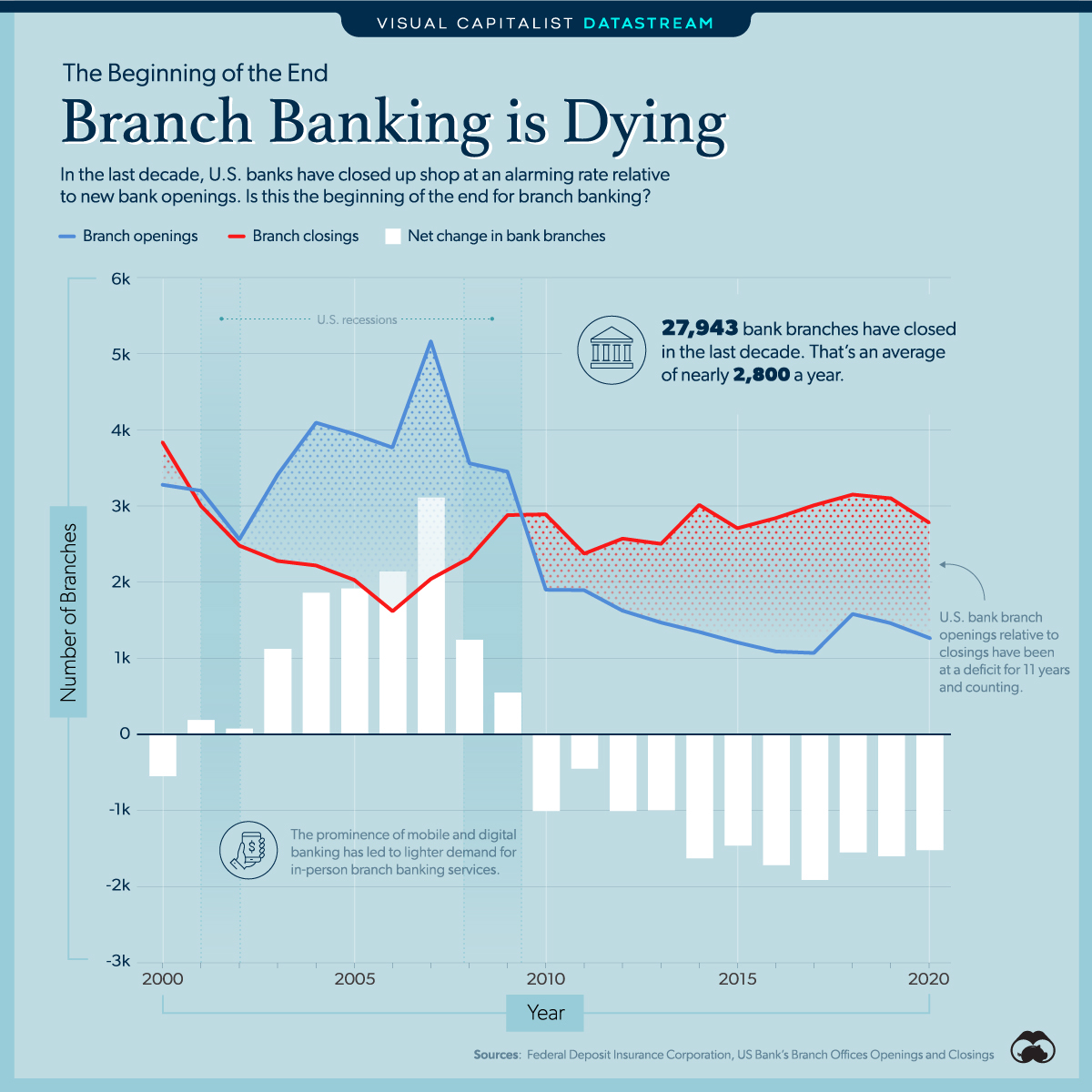 Source: visualcapitalist.com
So the important question is not only how many banking jobs AI will replace, but which tasks will disappear, which professions will change and where new jobs will emerge.
How Will AI Change the Banking Customer Experience?
AI will change the banking customer experience from reactive digital self-service into proactive, predictive and increasingly autonomous financial assistance. Today, customers still have to understand what they need, find the right banking feature and manually complete a journey. Over the next decade, this model will increasingly be replaced by intelligent financial systems that understand intent, anticipate needs, recommend actions and execute tasks on the customer's behalf.
By 2035, the banking experience may no longer revolve primarily around navigating accounts, payments, cards, loans and investments through screens. Instead, customers will increasingly define goals, preferences and boundaries while AI coordinates financial activity around them.
This changes the fundamental UX question from:
“How easily can customers complete a banking task?”
to:
“How intelligently and safely can the financial system act in the customer's best interest?”
Banking apps will not disappear, but their role will change. Instead of being primarily transaction interfaces, they will increasingly become control and insight centers where customers supervise AI, review outcomes, adjust permissions, simulate decisions and decide how much autonomy they are willing to delegate.
This means the next decade of banking will be shaped not simply by automation, but by the new relationship between human agency and financial intelligence.
Several major shifts will define this transformation.
1. AI Banking Assistants Will Evolve Into Financial Agents
The first generation of banking AI focused mainly on customer support: answering questions, searching FAQs and helping users find features. The next generation will go much further.
AI banking assistants will evolve into agentic financial systems capable of understanding goals, planning actions and completing multi-step financial tasks on behalf of customers.
Instead of asking, “Where can I find my savings account?”, a customer might say: "Make sure I have enough money for next month's expenses and invest anything I safely don't need."
The AI could analyze expected income, recurring bills, liquidity needs, savings goals and risk preferences before proposing—or eventually executing—a strategy within predefined permissions. This moves banking from conversational assistance to autonomous financial action.
Routine support requests will increasingly be resolved instantly by AI, reducing dependence on traditional contact-center operations. But human support will not disappear. Its role will shift toward complex, emotional, high-risk and exceptional situations where judgment, empathy and accountability matter most.
The future will therefore not be AI instead of humans. It will be AI handling routine complexity while humans focus on moments where human judgment creates the greatest value.

2. Digital Banking Will Shift From Destination to Invisible Infrastructure
The first digital banking revolution moved financial services from branches to websites and mobile apps. The next one will move banking beyond the app itself.
Financial services will increasingly become embedded into the contexts where customers actually need them—commerce, mobility, work, messaging, travel, healthcare and digital ecosystems.
Instead of opening a banking app to complete every task, financial actions may happen contextually:
- savings are automatically adjusted after income changes;
- financing appears when a purchase requires it;
- subscriptions are optimized before unnecessary costs accumulate;
- insurance adjusts when customer circumstances change;
- excess liquidity is automatically allocated according to predefined goals.
Banking therefore becomes less of a destination and more of an intelligent financial layer operating across everyday life. The banking app remains important, but increasingly as the place where customers see the bigger picture: what happened, what AI recommends, what it has permission to do and where human approval is still required.
3. Personal Finance Will Become Predictive Instead of Reactive
Traditional digital banking is largely historical. Banking dashboards show what customers have, what they spent and what happened to their money. AI will increasingly shift banking from explaining the past to anticipating the financial future.
Instead of simply reporting that spending increased, a banking system could predict that current behavior may create a cash-flow shortage three weeks from now and recommend corrective action before the problem occurs.
Instead of displaying an investment portfolio after market movements, AI could continuously simulate how different scenarios might affect long-term goals.
Instead of waiting for a customer to miss a payment, the bank could identify financial stress earlier and suggest appropriate options. This changes the role of financial UX from presenting information to enabling financial foresight.
The customer experience moves from:
“What happened to my money?”
toward:
“What is likely to happen next, and what should I do about it?”
Banks that can turn complex financial data into understandable, timely and trustworthy foresight will create significantly more value than those that simply digitize traditional account management.
4. Robo-Advisory Will Evolve Into Continuous AI Financial Guidance
Early robo-advisors automated relatively simple portfolio recommendations based on questionnaires, goals and risk tolerance. AI will transform this model into something far more dynamic.
Future financial intelligence will be able to continuously consider cash flow, savings, investments, liabilities, taxes, life events, market conditions and customer goals as one interconnected financial system.
Instead of receiving occasional investment recommendations, customers may have an always-on financial copilot continuously evaluating whether their financial decisions remain aligned with their objectives.
This could democratize access to forms of financial guidance that were previously available mainly through relationship managers, private bankers or wealth advisors. But greater intelligence also creates greater responsibility.
Customers must be able to understand:
- why the AI made a recommendation;
- which data influenced it;
- what assumptions were made;
- what could happen under alternative scenarios;
- whether the system can act automatically;
- how an action can be stopped or reversed.
The future of financial advice therefore depends not only on recommendation accuracy but on explainability, transparency and customer control.
5. Lending Will Shift From Static Applications to Intelligent Decision Systems
Traditional lending requires customers to search for a product, complete an application, submit documents and wait while the institution assesses eligibility and risk. AI, Open Banking and real-time financial data can increasingly collapse much of this process.
Creditworthiness can be assessed continuously using verified financial information. Documents can be interpreted automatically. Missing information can be identified instantly. Suitable financing can appear contextually when a customer actually needs it.
The result could be a shift from “apply for a loan” to “receive relevant financing when the need emerges.”
Over time, financial products themselves may also become more adaptive. Loans, credit limits, insurance and investment strategies could increasingly respond to changes in income, spending patterns, financial risk or other relevant circumstances rather than remaining completely static after they are opened.
For banking UX, this creates a new responsibility: customers must clearly understand how automated decisions are made, why conditions change and what control they retain.
The more invisible financial decision-making becomes, the more visible its UX logic must become.
6. Transactions Will Shift From Manual Execution to Intent-Based Banking
Digital banking dramatically simplified transactions, but customers still manually execute most financial actions. They choose an account, enter an amount, select a beneficiary, review details and confirm the payment.
Agentic AI could fundamentally change this interaction model. Instead of instructing the bank how to perform every step, customers will increasingly communicate intent: “Pay all recurring bills, keep enough cash for this month and move the remaining surplus toward my savings goal.”
The financial agent can determine the sequence of actions required to achieve that objective. This represents a shift from transaction flows to delegation flows. The customer no longer needs to control every click. Instead, the customer defines the rules under which the system is allowed to act.
New banking UX patterns will therefore become essential:
- AI permissions and spending limits;
- autonomy levels;
- approval thresholds;
- activity histories;
- decision explanations;
- scenario simulations;
- exception alerts;
- undo and reversal mechanisms.
The biggest UX challenge will no longer be making transactions frictionless. It will be making delegation understandable and safe.
7. Trust Will Become a Designed AI Experience
As AI assumes more responsibility, banking trust will increasingly depend on how the technology behaves. Customers will need confidence not only in the bank as an institution but also in the intelligent systems making recommendations and acting on their behalf.
This means transparency, explainability, controllability, privacy, security and reversibility will become core elements of the banking customer experience.
Customers should always understand:
- what AI is doing;
- why it is doing it;
- what information it uses;
- what it can do automatically;
- what still requires approval;
- how to change its permissions;
- how to reach a human;
- how to correct or reverse an outcome.
The objective should not be maximum automation. It should be the right level of autonomy for the right customer, task and level of financial risk.
Some customers will prefer highly autonomous finance in which AI continuously optimizes their financial life. Others will want AI to advise while keeping every important decision under their own control.
Future banks will need to support both.
Which Banking Jobs Are Most at Risk From AI?
Banking jobs built primarily around repetitive, standardized and information-processing tasks face the greatest exposure to AI and automation. Jobs requiring complex judgment, accountability, negotiation, empathy or relationship management are considerably harder to automate completely.
1. Back-Office and Banking Operations
Back-office banking contains many processes well suited to automation: data entry, reconciliation, document checking, transaction processing, report preparation and moving information between systems.
Generative AI and agentic AI can increasingly interpret documents, search internal knowledge, compare records, identify exceptions and trigger subsequent workflow steps. This does not mean banking operations will disappear. Instead, fewer employees may perform routine processing while more attention shifts toward investigating exceptions, controlling automated processes and resolving complex cases.
2. Bank Tellers and Routine Branch Services
Bank teller jobs were already being transformed by ATMs, mobile banking and self-service before generative AI arrived. The World Economic Forum now identifies Bank Tellers and Related Clerks among the fastest-declining occupations expected through 2030.
AI banking assistants can further reduce demand for simple branch and contact-center interactions by answering questions, locating information, explaining transactions and helping customers complete routine tasks digitally.
Branches are therefore unlikely to disappear everywhere, but their purpose is changing—from transaction processing toward advice, complex problem resolution and higher-value customer relationships.
3. Customer Service and Contact Centers
AI assistants can provide instant responses to common banking questions, search product information, explain fees, categorize issues and help customers navigate digital banking. This creates significant potential for customer-service automation.
But financial services also involve stressful situations, fraud, complaints, vulnerable customers and consequential financial decisions. In these cases, customers need clear access to human assistance rather than being trapped inside automated support.
The strongest banking model is therefore likely to combine AI-powered first-line assistance with intelligent human escalation.
4. KYC, AML and Compliance Processing
Know Your Customer, Anti-Money Laundering and compliance teams process enormous quantities of information. AI can support document extraction, identity verification, sanctions screening, transaction monitoring, alert prioritization and regulatory research. This can dramatically reduce manual workload.
But regulated banking decisions still require accountability. AI can identify patterns and recommend actions, while experienced specialists remain essential for interpreting ambiguous cases, managing regulatory risk and approving consequential decisions.
5. Entry-Level Analysis and Reporting
Generative AI can summarize long documents, analyze structured information, prepare first drafts, search research, create reports and accelerate financial modelling. This puts pressure on some of the repetitive work traditionally performed by junior analysts and associates.
The role of an analyst is therefore likely to shift from producing information to questioning, validating and interpreting AI-generated information. The value moves upward—from manual preparation toward judgment.
6. Standardized Credit and Loan Processing
AI can analyze financial information, classify documentation, identify missing data, support credit scoring and automate parts of standardized underwriting. Straightforward applications may therefore require considerably less manual processing.
But complex lending still involves exceptions, incomplete information, regulatory requirements and significant financial consequences. Human accountability, risk judgment and customer communication will remain important even when AI performs much of the underlying analysis.
Which Banking Jobs Will Grow Because of AI?
AI is creating a new layer of banking jobs focused on building, governing, securing and applying intelligent systems. Banks increasingly need AI and machine-learning engineers, data scientists, cybersecurity specialists, AI product managers, model-risk specialists, Responsible AI experts and professionals who can redesign operations around human-AI collaboration.
The World Economic Forum identifies AI and big data, networks and cybersecurity, and technology literacy among the fastest-growing skills, while analytical thinking remains one of the most important core skills for employers.
AI is unlikely to replace bankers as a single profession because banking jobs consist of many different tasks with very different levels of automation potential. A relationship manager might spend part of the day preparing reports, part analyzing customer information and part discussing a complex financial situation with a client.
AI may automate most of the reporting, accelerate the analysis and prepare recommendations. But building trust, understanding context, negotiating solutions and accepting responsibility for important financial decisions remain fundamentally different activities.
This distinction between job automation and task automation is crucial. Banks that treat AI purely as a headcount-reduction mechanism may capture short-term efficiency while missing the larger opportunity to redesign how employees and customers interact with financial services.
Banks will also continue to need people in roles where trust, context and accountability matter: relationship banking, complex wealth management, strategic advisory, sophisticated credit decisions, fraud investigation, product leadership and customer experience.
This creates an important paradox in the future of banking jobs: banks may employ fewer people to process information manually while employing more people to design, supervise and act upon intelligent systems.
Conclusion: From Digital Banking to Autonomous Financial Experience
Over the last decade, banking moved from branches toward digital self-service. Over the next decade, it will move from digital self-service toward intelligent financial autonomy.
The progression can be summarized as:
Branch banking → Digital banking → Conversational banking → Predictive banking → Agentic banking → Autonomous finance
This transformation will change far more than customer interfaces. It will reshape bank operations, customer service, financial advice, lending, payments, investments and the roles performed by banking employees.
Many routine operational tasks will increasingly be automated. At the same time, human work will move toward areas where judgment, accountability, strategic thinking, emotional intelligence and complex decision-making remain essential.
Digital banking solutions have already become the primary service channel for millions of customers. AI will take the transformation further by turning customer-centered banking from a collection of products and transactions into an intelligent financial system that understands context, predicts needs and increasingly acts on the customer's behalf.
The future of banking jobs will involve fewer people performing repetitive processing and more people working with AI to solve complex problems, manage risk and create better customer outcomes.
The broader labor-market transition supports this direction. The World Economic Forum expects the balance between work performed primarily by humans, primarily by technology and collaboratively by humans and technology to become much more evenly distributed by 2030.
For banks, the transition is already visible. Some organizations are reducing support and processing roles. Others are hiring AI specialists. Many are doing both at the same time.
This means the next generation of banking professionals will increasingly need a combination of financial expertise, AI literacy, analytical thinking, customer understanding, judgment and accountability.
The future bank may have fewer manual processors, but more AI orchestrators, digital strategists, UX designers, advisors, technologists and decision-makers.
AI will redefine what human work inside a bank is for.
YOUR ROAD TO REMARKABLE BANKING SERVICE
AI and Banking Jobs: Key Questions
Will AI replace banking jobs?
AI will replace some banking tasks and reduce demand for certain repetitive roles, but it is unlikely to replace banking jobs as a whole. Banks are simultaneously automating operations and hiring specialists in AI, data, cybersecurity and technology.
What banking jobs will AI replace first?
Roles dominated by repetitive information processing are most exposed, including parts of back-office operations, data entry, routine customer support, document processing, transaction reconciliation and standardized compliance work.
How many banking jobs could AI replace?
Bloomberg Intelligence estimated in 2025 that global banks could eliminate as many as 200,000 jobs over three to five years, although this is a forecast rather than a guaranteed outcome and different banks are following very different workforce strategies.
Will AI replace bank tellers?
Bank teller employment is expected to continue declining as mobile banking, self-service and AI automate routine branch transactions. The World Economic Forum lists bank tellers among the fastest-declining roles expected through 2030.
Will AI replace investment bankers?
AI can automate significant parts of research, document preparation, financial analysis and modelling, particularly at junior levels. Complex advisory, negotiation, relationship management, strategic judgment and accountability are much harder to automate completely.
Are banking jobs safe from AI?
The level of exposure depends more on the tasks performed than on the job title. Repetitive, rules-based and data-heavy activities face higher automation risk, while roles requiring judgment, trust, accountability and complex human interaction are more resilient.
What banking jobs will grow because of AI?
Demand is increasing for AI engineers, data scientists, cybersecurity specialists, AI product managers, model-risk and Responsible AI specialists, alongside professionals who can combine financial expertise with AI capabilities and human-centered customer experience design.
What skills will bankers need in the future?
Future banking professionals will increasingly need AI literacy, analytical thinking, technology literacy, risk awareness, communication, customer understanding and the ability to critically evaluate AI-generated recommendations rather than simply produce information manually.
Get UXDA Research-Based White Paper "How to Win the Hearts of Digital Customers":
 If you want to create next-gen financial products to receive an exceptional competitive advantage in the digital age, contact us! With the power of financial UX design, we can help you turn your business into a beloved financial brand with a strong emotional connection with your clients, resulting in success, demand, and long-term customer loyalty.
- E-mail us at info@theuxda.com
- Chat with us in Whatsapp
- Send a direct message to UXDA's CEO Alex Kreger on Linkedin