



When Alex Kreger and Linda Zaikovska-Daukste founded UXDA a decade ago, they made a decision that would define the company's future: to focus exclusively on financial services. At the time, complex financial services were not the most obvious industry for a design business driven by creativity and innovation. But after working on more than 150 financial products across 39 countries, UXDA has identified a recurring challenge: financial institutions invest heavily in technology and brand building, yet their digital experiences often fail to communicate what makes them different and valuable for customers.
Banks can spend millions introducing new platforms, features and technologies. But when their digital services look, feel and behave like everyone else's, much of that investment becomes invisible to customers. So, could design, often seen as an afterthought or just decoration, truly revolutionize finance?
The toughest markets need the softest touch. Confident in their beliefs, Alex and Linda embarked on a mission to demonstrate that human-centered design could play a pivotal role in the financial sector. Entering a market known for its cutthroat nature was a daunting challenge, but the UXDA founders were keen to introduce something completely new, aiming to transform financial services from the ground up.
But what began as a mission to humanize financial services has evolved into a specialized approach to creating distinctive Digital Brand Identities—turning financial UX strategy, customer understanding and design excellence into a strategic asset.
Here are five important lessons UXDA has gained from more than a decade of working exclusively with banking and financial services.

A Bold Vision: Transforming Finance Through Design
Without bold vision, even the strongest brands risk fading into the past. Entering a fiercely competitive market known for its conservatism, UXDA’s founders took a calculated risk.
Banks were complex, conservative and heavily regulated. Digital banking was often treated as a functional extension of existing services rather than an opportunity to redefine the relationship between financial institutions and their customers. Yet the UXDA owners recognized something important.
The more complex and emotionally significant a service is, the greater the value of designing its experience around people.
Money influences people's confidence, security, decisions and opportunities. Banking is not simply about checking balances or transferring funds. It is about helping individuals and businesses navigate important financial moments. This made finance one of the most meaningful industries in which to apply human-centered design.
UXDA started with a mission to make financial services more intuitive, accessible and enjoyable. But as the company worked with increasingly complex financial institutions, a bigger strategic challenge became clear. Improving usability was not enough.
Alex and Linda identified a critical issue plaguing financial brands—fragmented digital identities. Products, communications and strategies operated in silos, leaving customers disconnected.
The solution?
A cohesive digital journey that unified these disparate elements into a distinctive financial brand experience. Financial institutions needed to translate their business strategy, brand positioning and customer promise into a digital experience that could differentiate them in the market.
From the outset, UXDA's founders chose a distinctive path. Unlike generalist design agencies that accept any clients across various industries, UXDA focused exclusively on the financial sector.
It’s uncommon for design agencies to say “no” to clients. However, despite a high number of requests─over 2,000 inquiries in 10 years — UXDA had to limit its annual workload to just a few financial institutions, to ensure maximum quality and transformation for select clients. Such an exclusive approach allowed UXDA to design digital service solutions that weren’t just functional but tailored to the unique challenges and opportunities of each client's brand.
Today, UXDA brings experience from more than 150 financial products across 39 countries and 30 financial categories, ranging from everyday banking to investments, trading, wealth management and complex financial ecosystems.
UXDA's work transcends traditional interface design; it acts as a digital identity bridge, connecting users with financial brands. Such an exclusive and specialized approach resonated with clients and yielded outstanding results. Despite dealing with the complexities of large-scale financial products—some involving over 6,000 interface screens—UXDA has gained 5.0 rates on Clutch and Google.

Lesson 1. Brand Differentiation Must Become Digital Behavior
A financial brand is not defined by what it promises. It is defined by what customers experience. Financial institutions invest years building reputations around trust, innovation, customer centricity and distinctive values. But many of those promises disappear when customers open their banking apps.
Despite unique brand positioning and creative marketing campaigns, financial products frequently rely on similar interface structures, interaction patterns and service models. Customers encounter the same dashboards, navigation, transaction flows and increasingly the same AI-powered features.
The result is digital sameness.
When every bank offers comparable functionality through comparable experiences, it becomes harder for customers to recognize meaningful differences. This is why UXDA challenges the conventional understanding of brand identity in financial services.
Digital Brand Identity is the distinctive expression of a financial institution's brand purpose, positioning and values through the structure, behavior, interactions and visual language of its digital products.
Digital Brand Identity connects what a financial institution stands for with what customers actually encounter.
A bank positioned around simplicity should make complex financial decisions easier to understand. A wealth brand built around expertise should translate financial complexity into confidence and informed action. A financial institution promising empowerment should help customers feel more capable and in control.
The experience must prove the promise.
UXDA applies this principle by connecting brand strategy, customer needs and business objectives before defining the product experience. That's why UXDA's impact goes beyond aesthetics: its user-centric strategies drive measurable outcomes. Clients report significant improvements—50% increases in app adoption rates, 20-30% boosts in onboarding conversion and enhanced user retention and transaction completion metrics. By aligning business goals with user needs, UXDA delivers solutions that ensure both immediate and sustainable growth.
The goal is not to make a banking interface visually unusual. It is to create a recognizable, relevant and coherent experience that competitors cannot easily reproduce simply by copying functionality. Such focus ensures financial brands reduce the risk of missing out on substantial revenue growth and operational efficiencies that strengthen market positions. Instead of generic solutions, the UXDA agency is focused on long-term success and the empowerment of financial brands in an evolving landscape.
Key lesson: Digital differentiation becomes valuable when customers can feel the brand's distinctiveness in how the product actually works.

Lesson 2. Experience Fragmentation Can Erase Brand Value
Customers experience one financial institution, not its departments, technology vendors or organizational structure. Yet inside large financial organizations, digital products are frequently shaped by separate business units, legacy systems, technology platforms and competing stakeholder priorities.
Retail banking, business banking, investments, cards, lending and customer support may evolve through different roadmaps and design decisions. Each individual solution may appear reasonable. Together, they can create an inconsistent and fragmented digital ecosystem.
Customers experience this fragmentation as unfamiliar navigation, disconnected journeys, contradictory interaction patterns and unnecessary complexity. For the institution, the consequences extend beyond usability.
Fragmentation can weaken brand recognition, complicate product development, increase rework and make future innovation harder to integrate. UXDA describes the accumulation of these problems as Experience Debt—the future cost and complexity created when fragmented or poorly aligned experience decisions compound over time.
Experience Debt is not just an interface problem. It is often the result of decisions made across strategy, organization, technology and product development. This is why financial UX transformation requires more than redesigning individual screens.
UXDA approaches financial ecosystems through a unified experience logic that connects the institution's strategic goals with customer journeys, interaction principles, design systems and governance. Through its Digital Experience Governance (DXG) System, UXDA helps establish the principles and decision-making framework needed to maintain coherence as digital ecosystems evolve.
Key lesson: A coherent digital experience protects brand value and reduces the cost of fragmentation as financial institutions grow.
Lesson 3. The Most Expensive UX Mistakes Happen Before the First Screen
Technology determines what a financial institution can build. Experience strategy determines whether it is worth building.
In large banking transformations, significant decisions are often made long before designers begin developing interfaces. Institutions select core banking platforms, commit to technology vendors, define product architectures, prioritize features and approve substantial investments. These decisions can determine the limits of the future customer experience.
When strategic experience questions remain unresolved, organizations risk building technically capable products that fail to meet customer expectations or express a distinctive proposition. A digital banking platform may support hundreds of functions while providing no convincing reason for customers to adopt them.
A new super app may consolidate multiple services without creating a simpler or more valuable experience. An AI assistant may introduce advanced capabilities without improving the decisions customers actually need to make.
UXDA's experience across different banking markets has reinforced the importance of getting these early decisions right. That is why UXDA works upstream with financial institutions to challenge assumptions, define the future customer experience and align product strategy with business objectives before costly implementation commitments are made. This approach is particularly relevant before platform transformations, new digital propositions, major redesigns, mergers and AI integration programs.
The objective is not to design screens earlier. It is to make better decisions about what the digital experience should become.
Key lesson: The value of strategic financial UX often begins before design production—when the right decisions can prevent expensive mistakes.
Lesson 4. Launching Digital Functionality Does Not Guarantee Customer Adoption
The success of digital transformation is not determined by how much functionality a bank launches, but by how much meaningful value customers adopt.
Financial institutions continuously introduce digital capabilities, from onboarding and payments to investments, personal financial management and AI-powered assistance. But availability does not automatically create preference.
Customers must understand the value of a service, feel confident using it and find it relevant enough to change their existing behavior. This requires a deeper understanding of human decision-making, financial psychology and the conditions under which people trust new experiences.
UXDA connects customer research, behavioral insights, financial UX strategy and interaction design to close the gap between technical capability and customer adoption. The impact of this approach can be seen in financial products UXDA has helped transform.
For Emirates NBD's ENBD X digital banking experience, reported results include a 4.7-star app rating, a 50% increase in transactions and 91% adoption. For Bank of Jordan, the redesigned mobile banking experience was associated with an improvement in app rating from 2.8 to 4.7 stars.
These examples illustrate that financial UX transformation should be evaluated through customer and business outcomes, not merely the delivery of redesigned interfaces.
However, outcomes depend on multiple factors, including product strategy, implementation, market conditions and continued optimization.
The lesson is not that a particular design style guarantees better results. It is that successful digital transformation connects the financial institution's objectives with the motivations, expectations and behaviors of the people it serves.
Key lesson: Customer adoption grows when product value becomes clear, relevant and easy to experience—not simply when more functionality becomes available.
Lesson 5. Distinctive Digital Experiences Need Governance to Survive
A successful redesign creates a better experience today. Strong UX governance helps preserve its value tomorrow.
Large financial institutions rarely stop evolving after a major product launch. New business priorities emerge. Technology changes. Regulations evolve. Markets expand. New features, channels and AI capabilities are introduced.
Without shared experience principles, each change creates opportunities for inconsistency. An initially coherent product can gradually become fragmented as teams make independent decisions. This is why UXDA considers Digital Experience Governance a critical part of sustainable financial UX transformation.
UX governance connects business strategy, brand identity, customer needs, experience standards, design systems and decision-making accountability. It helps financial institutions retain strategic coherence as multiple teams and technologies contribute to the same ecosystem.
UXDA's DXG system is designed to make experience quality and brand differentiation more systematic rather than dependent on isolated design projects. This becomes particularly important when a financial organization operates across multiple products, markets, business units or technology vendors.
It is also essential as AI changes the structure of digital banking. When customers increasingly interact with financial services through intelligent assistants, proactive recommendations and automated actions, brand differentiation will depend less on the appearance of individual screens and more on the behavior, reliability and character of the overall experience.
Financial institutions therefore need experience principles that guide not only interfaces but also how intelligent systems communicate, make recommendations, request consent and maintain customer trust.
Key lesson: Digital Brand Identity becomes a sustainable strategic asset when it is supported by complete UX governance, not just a design system.
What Makes UXDA's Approach Different From a Generalist Design Agency?
UXDA's specialization is not simply a decision to work within one industry. It shapes how the company approaches strategic problems, evaluates alternatives and collaborates with financial organizations.
Finance-Native Expertise
UXDA has worked exclusively across banking and financial services for more than a decade. This provides familiarity with the complexity of financial customer behavior, regulatory expectations, trust, security, multi-product ecosystems and the operational realities of financial institutions.
The advantage is not simply faster onboarding into a project. It is the ability to identify financial UX challenges and patterns that may be difficult to recognize without extensive industry experience.
Pattern Intelligence Across 150+ Financial Products
Experience from 150+ financial products across 39 countries gives UXDA exposure to different business models, market conditions, customer expectations and technological environments. Each engagement adds to the company's understanding of what can strengthen or weaken a financial experience.
This accumulated knowledge helps UXDA challenge assumptions, benchmark potential directions and identify opportunities beyond familiar industry conventions.
Independent Strategic Judgment
A strategic UX partner should not simply execute decisions made elsewhere. UXDA brings an external perspective to important experience questions, challenging inherited conventions, internal assumptions and technology-driven compromises when they conflict with customer and business value.
The objective is to improve decision quality—not to produce more useless deliverables.
Strategy Connected to End-to-End Execution
A strong digital experience concept has limited value if its strategic intent disappears during delivery. UXDA connects UX research, product strategy, experience architecture, UI design, motion, design systems, validation and implementation support.
This continuity helps translate the original business and brand objectives into detailed experience decisions without losing the strategic direction along the way.
Together, these capabilities support UXDA's role as a specialized strategic partner in financial experience transformation.
A Boutique Model With Senior Involvement
The more voices you answer to, the less your own vision is heard. Conflicting interests and a diluted focus could compromise digital empowerment. To maintain a commitment to digital excellence and client success, UXDA maintains its independence. This allows to focus on an extraordinary level of craftsmanship that sets UXDA apart from other agencies.
Remaining independently owned and managed enables UXDA to stay true to its core values because agencies owned by everyone often stand for nothing. Unlike many agencies driven by different shareholder demands, UXDA prioritizes independence to empower financial brands with creativity and quality. With company executives actively involved in every project, UXDA ensures unwavering consistency and excellence.

As the independently owned and founder-led agency focusing solely on high-end, customized designs for a limited number of selected clients, the UXDA team is able to prioritize quality over quantity. Such an independent approach prevents a financial brand from becoming just another account in a large firm's portfolio, losing the personalized touch that empowers its digital advantage.

At the heart of UXDA’s unique approach is its in-house team of specialists. In an industry dominated by outsourcing, UXDA relies solely on a rigorously selected internal team with scientific grades and experience in finance, psychology, design and business. UXDA relies only on an in-house expert team to maintain consistency and foster deep expertise and collaborative effectiveness, while upholding a unified vision. This collaborative approach ensures clients the delivery of solutions that are swift, innovative and precise.
To build a dedicated in-house team comprised of seasoned UX experts, consultants, analysts, UI and motion designers with extensive experience in the finance sector, UXDA uses a rigorous hiring process, accepting only the top 1% of applicants and then investing up to two years in training new team members to ensure they meet and adhere to the highest in-house standards.
UXDA experts have become financial UX influencers with over 200 insightful publications, a financial UX podcast and groundbreaking design case studies that reach over a million financial professionals in 195 countries.
A New Benchmark in Financial UX Design
UXDA's approach goes beyond traditional UX, positioning the company as a leader in creating comprehensive digital experiences for the financial sector. The agency expertise lies in designing user-centered digital experiences that anticipate business strategic future needs while ensuring seamless integration across every end-user touchpoint.
By combining business strategy, psychological insights and design excellence, UXDA designs financial ecosystems that are not only highly functional but also deeply aligned with the brand's identity, delivering consistent and impactful user experiences.
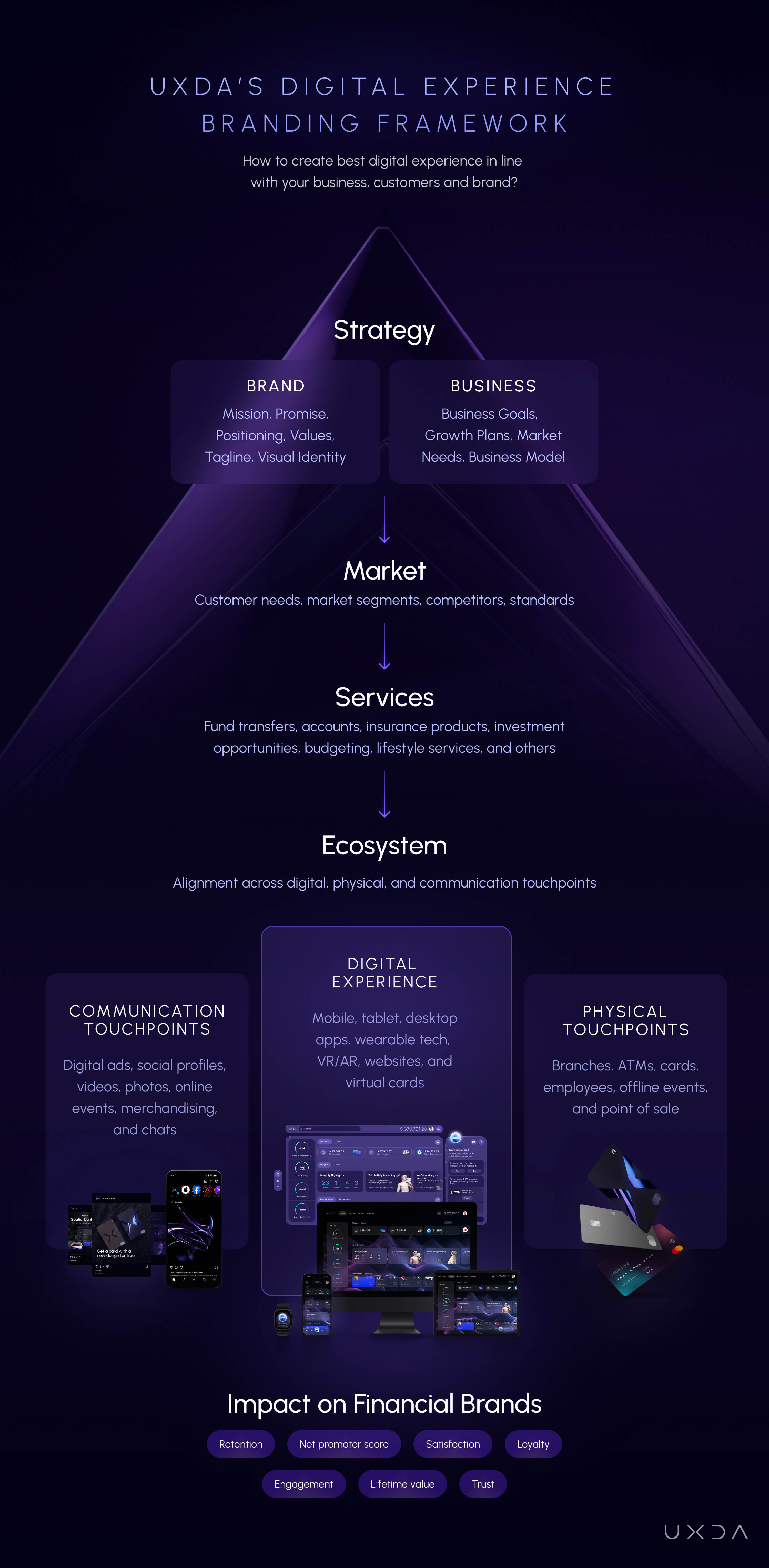
UXDA's holistic design approach evolves financial brands into cohesive, user-centered ecosystems, making financial services more accessible, empathetic and engaging. UXDA sets a new standard for what the financial industry can achieve, driving meaningful change and elevating the entire brand experience.
When digital finance embraces empathy, numbers transform into meaningful connections. By embracing complexity and staying committed to innovation and user-centered design, UXDA has managed to make a meaningful impact—not just for the agency's clients but for the millions of users who interact with the financial products developed by the agency.
By constantly exploring and innovating, you can find that the journey itself is the destination. The UXDA story is still unfolding, and the entire team is excited about what the future holds. The agency continues to explore new ways to innovate and improve, with the goal of improving the financial user experience.
UXDA used the power of bold vision and relentless innovation—a journey that proves design, when done right, can truly redefine the future of finance. Without their innovative edge, financial products risk falling behind, causing digital brands to miss advancements that provide competitive advantages. In a rapidly evolving digital world, innovation is key to empowerment and success.
How Has UXDA's Work Been Recognized Across Financial Services?
To work with the best, you must think like the best. UXDA's work spans leading financial institutions, FinTechs and digital financial ecosystems in different regions and categories.
UXDA experience includes projects for leading financial organizations such as ADCB, Emirates NBD, Garanti BBVA Securities, Banorte, CRDB, NMB, BKT, United Arab Bank, Bank of Jordan, SurePrep by Thomson Reuters, UNFCU, iGTB, Golden 1 and the GCash superapp, with its 90 million users. With over a decade of dedicated financial UX expertise, UXDA has mastered the nuances of the industry, enabling financial brands to navigate its complexities and unlock new opportunities.
Across these engagements, the strategic challenges vary significantly—from modernizing established banks and encouraging digital adoption to developing new financial propositions and designing complex multi-product platforms.
By choosing depth over breadth, UXDA ensures its clients benefit from unparalleled expertise—a critical factor in transforming complex financial products into user-centric experiences. Dedicated solely to financial UX design, UXDA has achieved amazing results that enhance brands' digital identities. Serving top-tier clients, including Fortune 500 companies, brought industry-leading insights and practices to product design and strategic UX.

Often, clients choose UXDA because they specifically want to collaborate with thе agency, trusting its unmatched competence, proven expertise and exceptional results. Dozens of leading financial brands are confident that only UXDA team can deliver the transformative digital experiences needed to achieve their goals. With such a specialized expertise, UXDA clients gain the support to navigate complex industry challenges effectively. Only a design-driven approach to digital transformation can improve market positioning and strengthen competitive advantages.
The more you understand your users, the more they'll understand your value. What truly sets UXDA apart is its unique methodology and design philosophy. While many agencies adopt generic design processes, UXDA believes the financial industry requires a specialized approach. The UXDA team has developed a user-centered design process specifically tailored for finance, integrating 44 proven design methods and 8 unique frameworks.
By leveraging deep analytics and understanding user behavior, the UXDA team creates intuitive interfaces that exceed expectations. The UXDA methodology aligns financial psychology, user-centered design and data-driven decision-making with regulatory needs, empowering digital brands to lead in innovation and user satisfaction.
Such specialized expertise is needed to ensure the depth of the design of digital interactions with the service and brand. Expertise is critical to the digital transformation and positioning of a financial brand in the market, especially when it seeks to provide an exclusive digital experience that sets it apart from the competition.
Revolutionizing with Innovation: Pioneering Financial UX/UI
True innovation in finance isn't coded in algorithms; it's crafted in the customer's experience. Without forward-thinking design, any product can become outdated, causing a financial brand to lose relevance. The spotlight of innovation shines brightest on those who put users first, casting others into shadow. That’s why customer-centered innovation design is the lifeblood of UXDA.

From introducing the first banking superapp interface to pioneering AI banking and spatial banking, UXDA continually pushes the boundaries of what’s possible in financial service design. By merging cutting-edge tech with design, UXDA doesn't follow the future of finance—it creates it.

Innovation isn't just an option in digital finance—it's the key to staying ahead. The UXDA team draws continuous inspiration from outside the financial industry, enabling them to bring groundbreaking innovations and experiences to their clients. This approach blends fresh perspectives with familiarity, helping to modernize and elevate the financial product experience.
UXDA's innovative financial solutions have gained over 30 international accolades, including the world’s top three design awards—Red Dot, iF Design Award and A’ Design Award. UXDA ensures digital brands remain ahead of the curve. These achievements provide independent recognition of the company's work.
But the most important value of 150+ financial transformations is not the number of projects, countries or awards.
It is the understanding accumulated from confronting different versions of the same fundamental challenge:
How can financial institutions turn their business ambitions, brand promises and technology investments into digital experiences customers actually value?
The Next Challenge: Differentiation in the Age of AI Banking
Financial services are entering another period of profound transformation. Generative AI, intelligent assistants, automated financial processes and increasingly agentic systems are changing what digital banking can become. Yet advanced technology alone will not guarantee differentiation.
If financial institutions implement similar AI models, capabilities and conversational interfaces, they may recreate the same digital sameness that already exists in traditional banking apps.
The competitive opportunity is therefore not simply to introduce AI faster. It is to define how intelligence should express the institution's values, strengthen customer trust, simplify financial decisions and deliver distinctive value.
For UXDA, this represents a natural continuation of the principles developed through more than 150 financial UX transformations. Technology enables new possibilities. Strategic user experience design determines how those possibilities become valuable to people. Digital Brand Identity must evolve from visual and interaction consistency toward a coherent experience that extends across interfaces, channels and intelligent systems. And Digital Experience Governance must help ensure that this identity survives continuous technological change.
From 150+ Financial Transformations to the Future of Digital Banking
UXDA was founded on the belief that financial services could become more human-centered through design. More than a decade and 150+ financial product engagements later, that belief has developed into a broader strategic perspective.
Financial UX is not simply about making banking easier to use. It is about enabling financial institutions translate strategy into experience, overcome fragmentation, improve critical decisions and create meaningful reasons for customers to choose their brands.
The true value of specialization lies in understanding not only how to design a better product, but how to avoid decisions that make it generic, fragmented or irrelevant.
Millions to build your financial brand. Decades to earn your reputation. Your digital experience decides whether customers believe it.
UXDA partners with financial institutions to turn that experience into a distinctive strategic asset. Because the future of financial services will not be defined only by who introduces the most technology. It will also be shaped by who creates the most meaningful experience of it.
Frequently Asked Questions
What is UXDA?
UXDA is an independent, specialized financial UX design and strategy partner focused exclusively on banking and financial services. It helps financial institutions translate business strategy and brand positioning into distinctive digital experiences through research, UX strategy, interface design and experience governance.
How many financial products has UXDA worked on?
UXDA has worked on more than 150 financial products across 39 countries and approximately 30 financial categories, including retail banking, business banking, investments, trading and financial ecosystems.
What is Digital Brand Identity in financial services?
Digital Brand Identity is the distinctive expression of a financial institution's brand purpose, positioning and values through its digital products, interactions, visual language and customer experience. It makes the brand recognizable through how its services behave, not only how they look.
How does UXDA differ from a generalist UX design agency?
UXDA works exclusively with financial institutions, combining sector-specific expertise, cross-market pattern intelligence, independent strategic judgment, boutique senior involvement and continuity from UX strategy to execution.
What is Experience Debt in digital banking?
Experience Debt is the accumulated cost and complexity created by fragmented, inconsistent or poorly aligned digital experience decisions. It can increase rework, weaken customer experience and make future changes more difficult.
What is UXDA's Digital Experience Governance System?
UXDA's Digital Experience Governance (DXG) System connects business and brand strategy with experience principles, design standards and decision-making structures. It is intended to help financial institutions maintain consistency, quality and differentiation as digital products evolve.
Why should banks involve UX experts before platform transformation?
Early UX strategy helps define the intended customer experience, priority journeys and product requirements before major technology decisions are finalized. This can reduce the risk of selecting platforms or architectures that constrain the experience the institution wants to deliver.
How can financial UX design support business growth?
Financial UX design can support business growth by reducing customer friction, improving clarity, strengthening trust, encouraging digital adoption and aligning digital services with meaningful customer needs. Measurable outcomes depend on product execution, market conditions and ongoing optimization.
Get UXDA Research-Based White Paper "How to Win the Hearts of Digital Customers":

Make your financial brand unmistakable in digital:
Explore how UXDA helps financial institutions create distinctive Digital Brand Identities, define stronger financial UX strategies and establish the governance needed to sustain their competitive advantage.
- E-mail us at info@theuxda.com
- Chat with us in Whatsapp
- Send a direct message to UXDA's CEO Alex Kreger on Linkedin